
Home › Lions News › Rugby 101
Rugby 101Leg drive in rugby: how to drive through the tackle
The carry doesn't end when the tackler hits you. What happens in the next second, when you keep your feet pumping, decides whether you win the gainline or get driven back. Here's what the research says about leg drive in contact, how to do it safely under the new tackle laws, and how strength work builds it.
Key facts at a glance
- Gainline winner: front-on, 64% of successful carries used leg drive vs 25% when the tackler won (odds ratio 5.22; Tierney, Denvir, Farrell and Simms, 2018)
- Side-on too: leg drive was the only ball-carrier action significantly linked to gainline success in side-on tackles (47% vs 21%, odds ratio 3.25)
- International data: across 4,479 tackles in the 2014 Six Nations and Championship, fending and leg drive increased the chance of an offload or tackle break (Hendricks et al., 2017)
- No extra head-injury risk found: in 74 elite tackles where the tackler left for a head injury assessment, leg drive was not associated with tackler HIA risk in any tackle type (Tierney et al., 2019)
- Strength matters: gains in squat strength over an 8-week pre-season were the strongest correlate of improved contact (tackling) ability in rugby league players (r = 0.60; Speranza et al., 2016)
- New law: since 1 July 2026, Law 14.1 says "the ball carrier has a responsibility to enter the tackle safely" (World Rugby)
- New protection: the hip-drop tackle, which often injures the ball carrier's legs, is banned under Law 9.13 from 1 November 2026
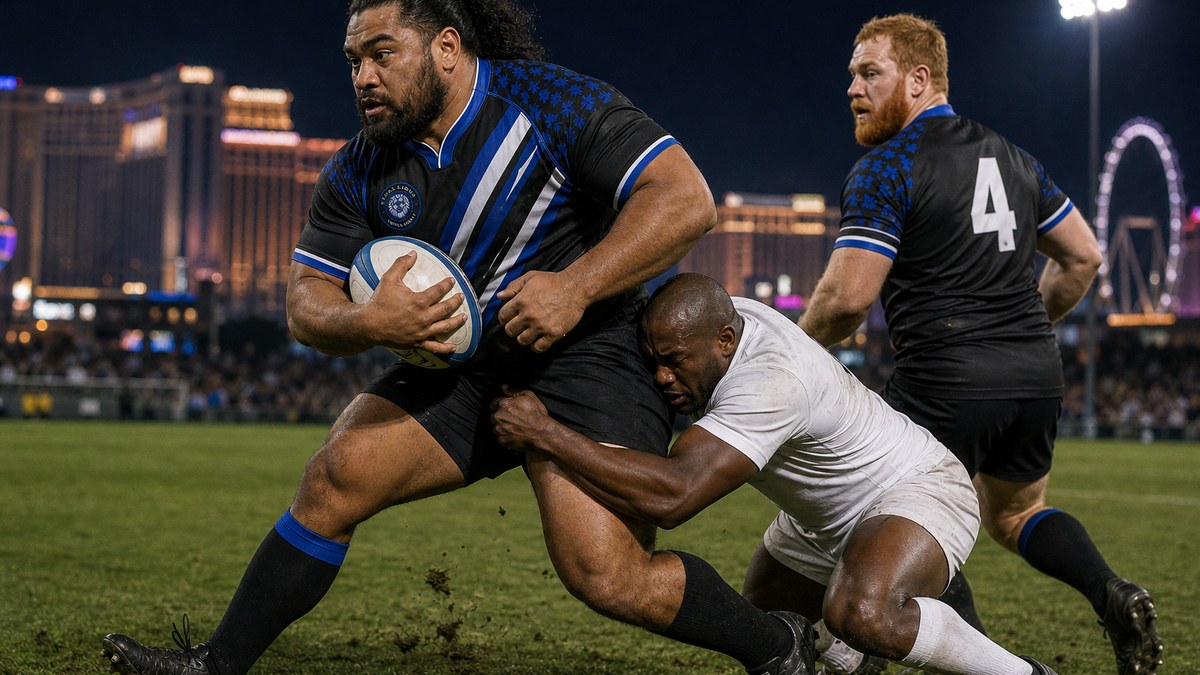
Every rugby player has seen it. A carrier takes the ball flat, hits the line and, instead of stopping dead, keeps the legs pumping. Two meters later the tackler is going backward, the support is arriving on the front foot and the defense is scrambling. That extra yard or two doesn't happen by accident. It's leg drive, and it's one of the most important habits a ball carrier can build.
At the Vegas Lions, our identity is raw power and explosive strength. We've covered strength training for rugby, plyometrics, acceleration and how to run hard lines and win the collision. This guide covers what happens after the hit: how to keep driving through the tackle, what the research says, and how to do it safely. It's general information, not a personal program. Contact skills carry real risk, so learn them progressively under a qualified coach.
What is leg drive in rugby?
Leg drive is simple to describe and hard to do under pressure. As contact happens, the ball carrier keeps the feet moving with short, quick, powerful steps, pushing the ground backward to keep forward momentum. Instead of absorbing the hit and stopping, the carrier keeps working through it.
It matters because the tackle is a contest of momentum. If the tackler's force wins, you go backward and the defense gets a slow ball to compete for. If your drive wins, you finish over the gainline, the tackler ends up on the wrong side and your team gets quick, front-foot ball. Even a meter matters: it forces defenders to retreat and realign, and it makes the next ruck far easier to win.
Leg drive isn't only for forwards. Centers taking the ball into midfield, wings stepping back inside and scrum-halves sniping all finish carries with it. It also shows up in set pieces: the Vegas Blackjacks' guide to the rolling maul and their scrum technique guide show how the same "short steps, low hips, keep pushing" principle drives a whole pack forward.
The hit is not the end of the carry. It's the start of the second half of it. A player who switches off on contact gives the defense a free win. A player who keeps driving makes every tackle hard work. That's what "Power" means in The Lions Code.
What does the research say about leg drive?
Several video-analysis studies of professional rugby union have looked at which ball-carrier actions predict a good outcome in the tackle. Leg drive keeps coming up.
It wins the gainline
Gregory Tierney and colleagues at Trinity College Dublin analyzed 122 front-on and 111 side-on tackles from European Rugby Champions Cup matches, published in the International Journal of Sports Science and Coaching in 2018. In front-on tackles, ball carriers used leg drive on contact in 64% of the tackles they won, compared with 25% of tackles the defender won, an odds ratio of 5.22. In side-on tackles, leg drive was the only ball-carrier characteristic significantly linked to gainline success (47% vs 21%, odds ratio 3.25). Interestingly, simply getting lower (going from upright to low) was not significant on its own. It's what you do with your legs after contact that counted.
It helps break tackles and offload
A larger study by Sharief Hendricks and colleagues, published in the Journal of Sports Sciences in 2017, coded 4,479 tackles from every match of the 2014 Six Nations and Rugby Championship. Their conclusion: "Fending and leg driving during contact increased the likelihood of a ball-carrier offload or tackle break." They also found the mirror image for defenders: front-on shoulder tackles where the tackler drove their legs reduced the chance of a ball-carrier offload or tackle break. Whoever drives harder tends to win the contest.
It wasn't linked to head injuries for the tackler
Safety matters as much as performance. A 2019 study by the same Trinity College group in the Journal of Sports Sciences compared 74 elite tackles where the tackler was removed for a head injury assessment (HIA) with 233 control tackles. Leg drive on contact was not associated with tackler HIA risk in any type of tackle. What was linked to higher risk in front-on upper-body tackles was "fending into contact," especially when the forearm or elbow, rather than an open palm, met the tackler's head, and an explosive change in speed right at contact. The authors stressed that tackler technique is the main focus for head injury prevention, but the message for carriers is clear: drive with the legs, keep the arms and elbows away from heads.
| Study | Sample | Leg drive finding |
|---|---|---|
| Tierney et al., 2018 (IJSSC) | 233 tackles, European Champions Cup | Front-on: odds ratio 5.22 for gainline success (64% vs 25%). Side-on: odds ratio 3.25 (47% vs 21%) |
| Hendricks et al., 2017 (J Sports Sci) | 4,479 tackles, 2014 Six Nations and Rugby Championship | Leg drive and fending increased the chance of a tackle break or offload |
| Tierney et al., 2019 (J Sports Sci) | 74 HIA tackles vs 233 controls, elite men's rugby | Leg drive not associated with tackler HIA risk in any tackle type |
| Speranza et al., 2016 (JSCR) | 24 semi-professional rugby league players | Gains in squat strength correlated with improved contact (tackling) ability, r = 0.60 |
These are observational studies of elite men's rugby. They show strong associations, not proof that leg drive alone causes success, and the authors note results may differ at community and youth level. But the pattern is consistent.
How do you drive your legs through a tackle?
Leg drive starts before contact. If you arrive upright, flat-footed and slow, there's nothing to drive with. Coaches usually break it into a few stages. Treat these as general cues to work on with your coach, not a self-taught contact program.
1. Arrive with speed and a plan
Running a hard line at the right angle, as our carry guide explains, gives you the momentum to drive. Short, quick steps in the last couple of meters keep you balanced and let you adjust to the tackler. Avoid a sudden, wild burst straight into the defender's head height; controlled power is better than a last-second lunge.
2. Get square and strong
As contact approaches, sink the hips and bring the chest forward over the knees with a flat back. Keep the chin up and eyes forward, never down at the grass. The head should stay up and out of the line of contact. Under the new laws, ducking or dipping your head into a tackler isn't just dangerous; it can be penalized where competitions adopt the optional ball-carrier sanction.
3. Protect the ball
Two hands on the ball, or one arm locked over it, tight to the body. A loose ball in contact turns a good drive into a turnover. Keep the elbows tucked in; leading with an elbow or forearm into the tackler's head is illegal and dangerous.
4. Pump the legs: short, fast, powerful
This is the drive itself. Keep the feet moving with short steps under your hips, pushing the ground backward. Long strides lift you up and make you easy to stop. Think "pistons," not "long jump." Many coaches cue players to drive for "two more steps" after the hit.
5. Finish well
When you're going down, go down on your terms: turn to face your own support, land safely and place the ball back long and quickly. The Blackjacks' rucking guide explains why fast, well-placed ball wins the next phase. In the Hendricks study, actively placing the ball after the tackle was linked to keeping possession.
| Phase | Coaching cue | Common mistake |
|---|---|---|
| Approach | Hard line, controlled speed, short steps in the last 2 m | Slowing to a stop or lunging at the last moment |
| Body position | Hips low, flat back, chest over knees, chin up | Standing upright or dipping the head |
| Ball security | Two hands or one arm locked over the ball, elbows in | Ball held loose and away from the body |
| Contact | Shoulder and chest absorb, head clear of the tackler | Leading with the head, elbow or forearm |
| Drive | Short, fast steps pushing the ground back; "two more steps" | Long strides, feet stopping on impact |
| Finish | Turn to support, land safely, place the ball back long | Twisting awkwardly, losing the ball forward |
Is leg drive safe under the 2026 tackle laws?
Good leg drive is legal and, done well, safer than collapsing into contact. But rugby's laws have changed this year, and every ball carrier should know them.
- Ball carrier responsibility. World Rugby's Council approved new law wording on 17 June 2026, reflected in the laws from 1 July 2026. Law 14.1 now states: "The ball carrier has a responsibility to enter the tackle safely."
- Lower tackle height in community rugby. Community tacklers must now tackle below the waist or base of the sternum (the union decides which), while the shoulder line remains the limit in elite rugby. Expect more tackles around the hips and thighs, which is exactly where a carrier's leg drive meets the tackler.
- Optional ball-carrier sanction. Under the Game On variations, competition organizers may choose to penalize ball carriers who drop their body height significantly before making dangerous contact with a tackler. Drive low from the start rather than ducking at the last moment.
- Hip-drop tackle ban. From 1 November 2026, the hip-drop tackle is illegal under Law 9.13. World Rugby defines it as a tackler grasping a ball carrier from the side or behind, swinging round or through and dropping their hips or body weight onto the carrier's legs. World Rugby says these tackles "often lead to significant injuries to the ball carrier." The change protects exactly the legs a carrier uses to drive.
Rules for the APR Games 2027 will be confirmed with player registration. For the defensive side of the same contest, the Vegas Knights' safe tackling guide explains tackle height and technique, and their breakdown defense guide shows what defenders do once you hit the ground.
The new laws reward the right kind of power. Lower tackles mean the carrier who stays balanced and keeps driving through the hips and thighs wins more contacts. Dropping your head into a tackler was never smart; now it can cost your team a penalty too.
How do you build strength for leg drive?
Leg drive is a skill, but it runs on strength. You can't push the ground backward hard with weak legs. Michael Speranza and colleagues tested 24 semi-professional rugby league players before and after an 8-week pre-season of strength and power training (Journal of Strength and Conditioning Research, 2016). Changes in 3-rep-max squat strength had the strongest relationship with improved contact ability in a standardized tackling test (r = 0.60). A follow-up in-season study (2017) found players who kept their lower-body strength improved their contact skills during the season, while losing squat strength was linked to declines. These studies measured tackling, not ball carrying, and samples were small, but both sides of the collision depend on the same leg strength.
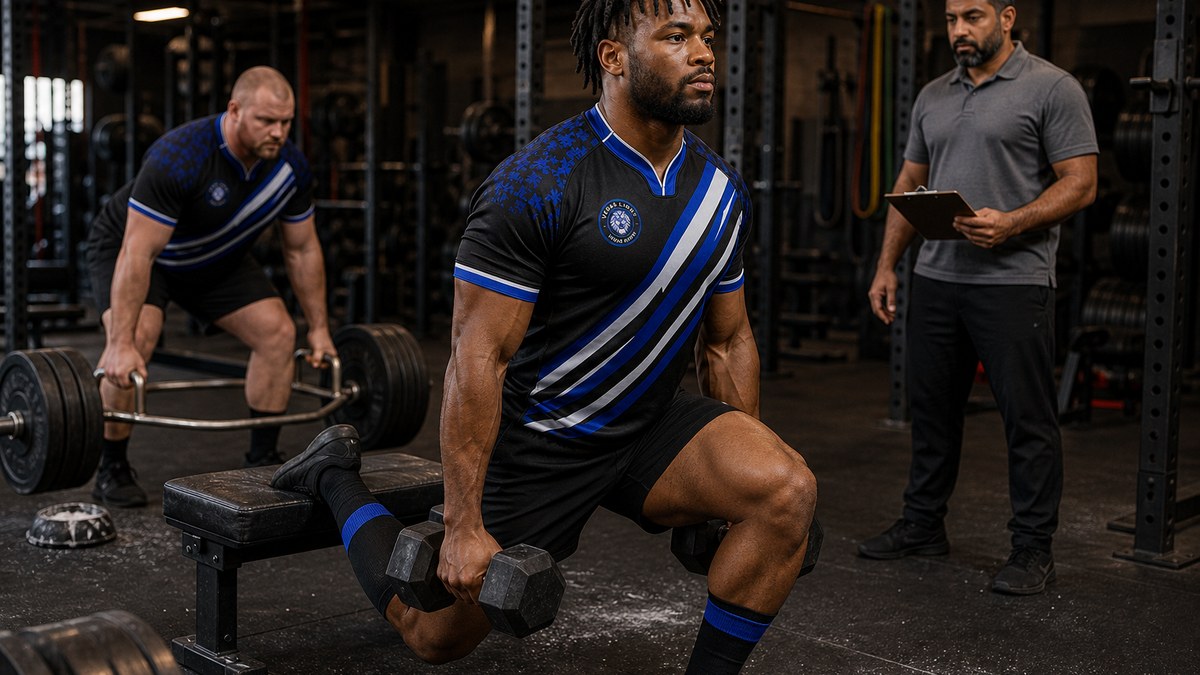
Most strength and conditioning coaches build leg drive with a mix of:
- Squat and hinge strength: back or front squats, trap-bar deadlifts and hip thrusts for raw force production. Our strength training guide covers the basics.
- Single-leg work: split squats, rear-foot-elevated split squats and step-ups, because you drive one leg at a time.
- Power: jumps and bounds to apply force quickly. See our plyometrics guide.
- Pushing and sled work: heavy sled pushes with short steps and a low body angle mimic the drive position.
- Trunk and neck strength: a strong, stable trunk transfers leg force and holds your posture under impact. Neck strength is a topic coaches take seriously, and one we'll cover in a future guide.
What drills build leg drive?
Good coaches progress contact gradually, from no contact to controlled contact to live contact. Here's how many programs build it. Intensity, volume and progression should always be set by a qualified coach who knows the group.
| Stage | Example drill | Focus |
|---|---|---|
| 1. No contact | Wall drives and partner-resisted marches (partner holds the hips from the front) | Body angle, short steps, flat back, chin up |
| 2. Sled | Short, heavy sled pushes at a low angle | Force into the ground, pistons not strides |
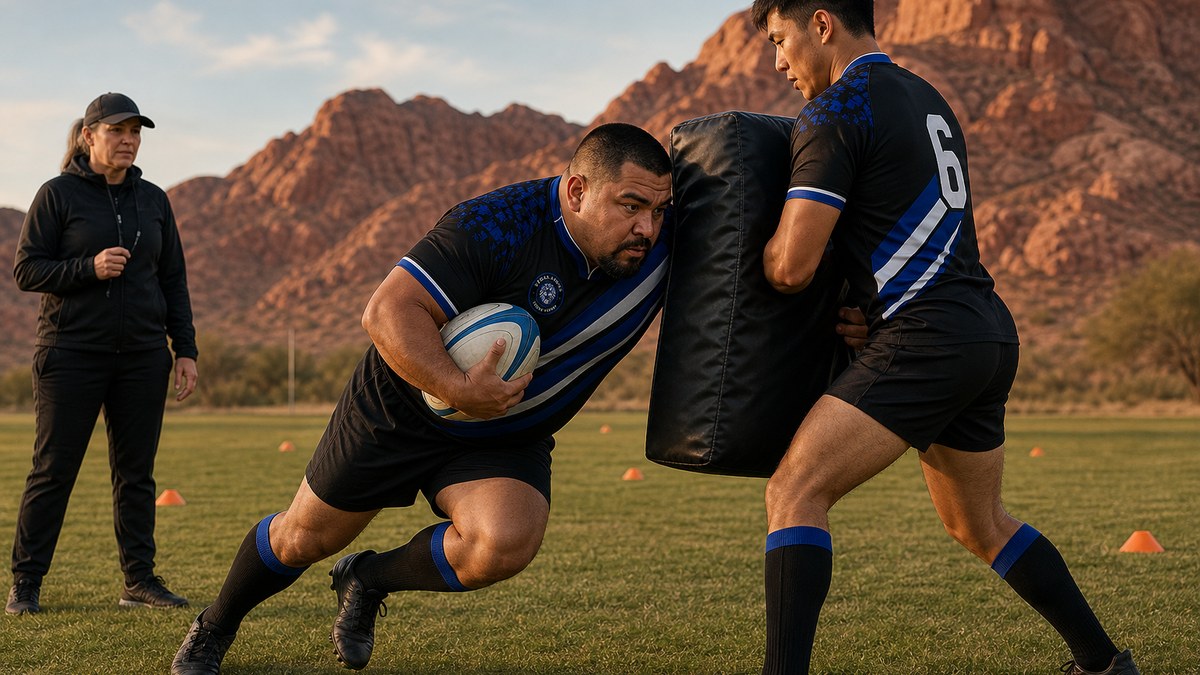
| 3. Shield | Carry into a held hit shield, drive three to five steps, then place the ball | Ball security, head clear, finishing |
| 4. Controlled contact | One-on-one at walking or jogging pace with a coached tackler and a tackle bag | Driving through contact at the new tackle height |
| 5. Game context | Carry off a pass with support players arriving to the ruck | Decision-making, linking drive to quick ball |
Contact sessions usually stay short and sharp, with full attention to technique. Many coaches keep heavy contact away from the days around matches. Before training, a structured warm-up such as World Rugby's free Activate program prepares the body; World Rugby says it is linked to fewer soft tissue injuries and concussions.
Does leg drive look different for forwards and backs?
The principle is the same but the situations differ. If you're unsure what each position does, the Vegas Kings' guide to rugby positions breaks it down.
- Props, hookers and locks drive mostly over very short distances in tight traffic: pick-and-goes, short carries off the scrum-half and in mauls. Mass plus a low drive gives them a lot of momentum.
- Back-rowers are often the main carriers, hitting the line repeatedly. Leg drive and quick ball placement are bread and butter for a number 8.
- Centers take contact in midfield and need to win the gainline to give the backline front-foot ball.
- Half-backs and outside backs carry less into heavy traffic, but when caught they still need to keep the legs moving and finish the carry well.
Does leg drive matter in 10-a-side rugby?
The APR Games 2027 are 10-a-side rugby, two 20-minute halves, Memorial Day weekend, May 29–31, in Las Vegas. With fewer defenders, a single tackle break can turn into a long-range try, and a carrier who wins every collision keeps the defense on the back foot. Rucks contain fewer bodies, so winning the gainline and placing the ball quickly matters even more. And because the format is fast and intense, players need the strength to keep driving deep into the second half. New to the game's basics? Downtown Rugby's rules for beginners is a good place to start.
Bring your power to the APR Games
The APR Games 2027 run Memorial Day weekend, May 29–31, in Las Vegas: 10-a-side rugby, two 20-minute halves under the lights. Men's Elite ($10,000 prize pool), Women's Social ($5,000) and Youth divisions. Player entry $299 includes a team jersey, kit bag, at least three pool games and opening-night access.
Join the APR Games waitlistWant to learn contact skills in person? The APR coaching clinic runs May 28–31, 2027, in Las Vegas. The Lions are one of five founding franchises of American Pro Rugby; meet the others on the APR teams page, follow the wider game on APR's rugby news and pick up training gear at the APR merch store.
Tracking your squat numbers and contact sessions over a season makes progress easier to see. Our partner Vibe Coding covers tech and apps if you like building your own tools. And if you run a club, gym or venue, our partner American LED Signage works on signage for venues and businesses.
Want one skill broken down and a strength block every week? Join The Breakdown, APR's free weekly newsletter.
Frequently asked questions
What is leg drive in rugby?
Leg drive is when the ball carrier keeps the feet moving with short, powerful steps through and after contact instead of stopping when tackled. It helps the carrier win the gainline, break tackles and set up quick ruck ball.
Does leg drive really make a difference?
Yes. In a study of elite rugby union tackles, ball carriers who drove their legs on contact were about five times more likely to win the gainline in front-on tackles, and leg drive was the only carrier action linked to success in side-on tackles.
Is leg drive dangerous?
Done with good technique it is a normal, legal part of carrying. A study of elite tackles found leg drive was not associated with head injury assessments for the tackler. The risks come from leading with the head, elbow or forearm, so keep the chin up and arms tucked.
Should I get low before contact?
Get low and square early with a flat back, rather than ducking at the last second. Research found simply dropping from upright to low did not predict success on its own, and some competitions can now penalize carriers who drop their height significantly into dangerous contact.
What does the new law say about ball carriers?
Since 1 July 2026, World Rugby Law 14.1 says the ball carrier has a responsibility to enter the tackle safely. Community rugby also lowered the legal tackle height to the waist or base of the sternum, depending on the union.
What is a hip-drop tackle and is it banned?
A hip-drop tackle is when a tackler grabs a ball carrier from the side or behind, swings round and drops their hips or body weight onto the carrier's legs. It has been illegal under World Rugby Law 9.13 since 1 November 2026 because it often injures the ball carrier.
What exercises improve leg drive?
Squats, trap-bar deadlifts, split squats, step-ups, sled pushes and jump training are common choices. Research in rugby league players found gains in squat strength were closely related to improved contact ability.
How many steps should I drive after contact?
There is no fixed number. Many coaches cue players to drive for two more steps after the hit, then finish by turning to support and placing the ball back quickly before being held.
Do backs need leg drive too?
Yes. Forwards use it most, but centers, wings and half-backs all get tackled, and finishing a carry with leg drive and good ball placement helps their team keep momentum.
How should beginners learn leg drive?
Progressively and under a qualified coach: start with no-contact body position drills, then sleds and hit shields, then controlled contact before live tackles. Never learn contact skills on your own.
Keep reading
Sources
- Tierney GJ, Denvir K, Farrell G, Simms CK. The effect of technique on tackle gainline success outcomes in elite level rugby union. International Journal of Sports Science and Coaching 13(1):16–25, 2018
- Hendricks S, et al. Technical determinants of tackle and ruck performance in International rugby union. Journal of Sports Sciences 36(5):522–528, 2017
- Tierney GJ, Denvir K, Farrell G, Simms CK. Does ball carrier technique influence tackler head injury assessment risk in elite rugby union? Journal of Sports Sciences 37(3):262–267, 2019
- Speranza MJA, Gabbett TJ, Johnston RD, Sheppard JM. Effect of strength and power training on tackling ability in semiprofessional rugby league players. Journal of Strength and Conditioning Research 30(2):336–343, 2016
- Speranza MJA, et al. Changes in rugby league tackling ability during a competitive season: the relationship with strength and power qualities. Journal of Strength and Conditioning Research 31(12):3311–3318, 2017
- World Rugby Passport: Community tackle height law wordings approved, 17 June 2026 (effective 1 July 2026)
- World Rugby Passport: Law change, hip drop tackles, in effect from 1 November 2026
- World Rugby Passport: Activate injury prevention program
- American Pro Rugby: APR Games 2027
This guide is general information, not individual coaching or medical advice. Contact skills carry a risk of injury: learn them progressively under a qualified coach, follow your competition's laws, and consult a doctor or physiotherapist before training after an injury or if you have any health concerns.