
Home › Lions News › Training
TrainingStrength training for rugby: how to build power for contact
Rugby is a collision sport, and strength is what lets you win those collisions and keep playing. Here is how rugby players build strength and power, what the research says about injury prevention, and a simple weekly structure you can start with.
Key facts at a glance
- Why strength matters: stronger players win more collisions, hold their shape in scrums and rucks, and are better protected against injury
- Injury evidence: strength training reduced sports injuries to under one-third in a 2014 meta-analysis (Lauersen et al., BJSM); stretching alone showed no effect
- Rugby-specific evidence: World Rugby's Activate program is linked to 26–40% fewer soft-tissue injuries and 29–60% fewer concussions in youth and adult players
- Frequency: the schools study behind Activate recommended doing the program at least three times a week
- Beginners: use rep ranges (for example 3 sets of 8–12) and add load when all reps are completed; 1RM-based percentages are for later
- Safety: learn the big lifts under a qualified coach; technique first, load second
Watch a scrum engage or a forward carry into three defenders and you understand why rugby players live in the weight room. Strength training for rugby isn't about building a bodybuilder's physique. It's about producing force quickly, absorbing it safely and doing that again and again for 80 minutes.
At the Vegas Lions, power is in our name and our code. One of our pillars is "Raw power: explosive strength training," and the second value in The Lions Code is Power: "Explosive force in every contact." This guide explains how rugby strength and power training works, what the evidence says, and how to start safely.
Why do rugby players need strength training?
Rugby is a collision sport. In every match you tackle, get tackled, clear rucks, drive mauls and, if you're a forward, scrum. Each of those is a contest of force. Stronger, more powerful players:
- Win the gain line. A powerful carry pushes defenders backward; a powerful tackle stops the carrier dead.
- Win the breakdown. Clearing a ruck or holding a jackal position depends on strength in the hips, legs and trunk.
- Hold the set piece. Scrums and lineout lifts demand serious lower-body and upper-back strength.
- Accelerate faster. Sprinting from a standing start is largely about how much force you can put into the ground, fast.
- Stay on the field. Strong muscles, tendons and ligaments are better able to handle the forces of contact and change of direction.
Strength is the foundation, but power wins the moment. The goal isn't the biggest number on a lift. It's the most force in the shortest time when you hit the line. Build strength first, then learn to use it fast.
Does strength training prevent rugby injuries?
This is the strongest argument for lifting. In 2014, researchers Jeppe Bo Lauersen, Ditte Marie Bertelsen and Lars Bo Andersen published a meta-analysis in the British Journal of Sports Medicine looking at exercise programs to prevent sports injuries. They found that strength training reduced sports injuries to less than one-third, while preventive programs roughly halved overuse injuries. Stretching alone showed no beneficial effect.
Rugby has its own evidence. World Rugby's Activate program, developed by World Rugby researcher Dr Mike Hislop with England Rugby and the University of Bath and launched in September 2019, is a structured warm-up that includes balance, whole-body resistance exercise, plyometrics (jumping and landing) and change-of-direction work. According to World Rugby and the University of Bath:
- In youth players, it was linked to 26% fewer soft-tissue injuries and 29% fewer concussions.
- In adult players, it was linked to 40% fewer soft-tissue injuries and 60% fewer concussions.
The schools study behind it involved 3,188 players aged 14 to 18 from 118 teams, and its authors recommended doing the program at least three times a week for the greatest effect. In the adult club study, players who stuck with the program more closely saw fewer and less serious targeted injuries. Activate has versions for Under-15, Under-16, Under-18 and adults, with levels that progress through the season.
What is the difference between strength and power?
Strength is the maximum force your muscles can produce: how much you can squat, deadlift or press. Power is how quickly you can produce force: force multiplied by speed. In rugby, a tackle or a leg drive happens in a fraction of a second, so power is what shows up on the field.
The two are connected. You can't express power you don't have, so strength comes first. That's why most rugby programs build a strength base and then add explosive work on top of it, such as jumps, throws and fast lifts.
| Quality | What it is | Typical training | Where it shows up in rugby |
|---|---|---|---|
| Maximal strength | Most force you can produce | Heavy squats, deadlifts, presses and rows; low reps, long rests | Scrums, mauls, holding a jackal, lineout lifting |
| Power | Force produced quickly | Jumps, medicine-ball throws, Olympic-lift variations, lighter loads moved fast | Tackles, leg drive, acceleration, hitting rucks |
| Muscle size (hypertrophy) | More muscle mass | Moderate loads, more sets and reps, taken close to failure | Absorbing contact, body mass for collisions |
| Strength endurance | Repeating efforts | Circuits, carries, sled work, shorter rests | Repeated rucks, tackle after tackle late in a game |
| Landing and control | Absorbing force safely | Single-leg balance, landing drills, change of direction | Cutting, landing from lineouts, injury resilience |
What are the best strength exercises for rugby players?
You don't need dozens of exercises. Most rugby programs are built on a handful of big movement patterns:
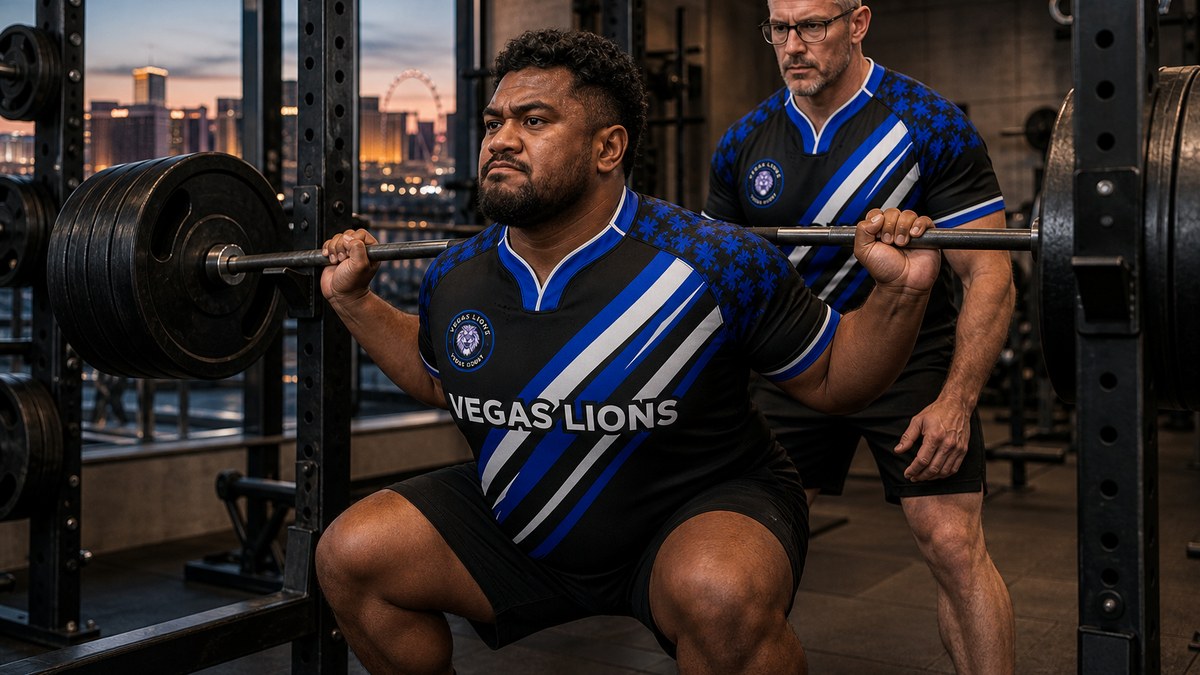
- Squat (knee-dominant): back squat, front squat, goblet squat for beginners. Builds leg drive for scrums, rucks and acceleration.
- Hinge (hip-dominant): deadlift, Romanian deadlift, trap-bar deadlift. Builds the hips and posterior chain for driving and lifting.
- Single-leg work: split squats, step-ups, lunges. Rugby is played on one leg at a time.
- Upper-body push: bench press, push-ups, overhead press. For fends, tackles and binding.
- Upper-body pull: rows, pull-ups. Balances pressing and builds the upper back used in scrums and rucks.
- Trunk: planks, carries, anti-rotation work. Transfers force from your legs to the contact.
- Power: box jumps, broad jumps, medicine-ball throws and, once technique is coached, Olympic-lift variations like hang cleans.
- Neck: many rugby programs include neck strengthening for contact. Learn it from a qualified coach or physiotherapist.
Pick five or six lifts and get really good at them. Most new players don't need a fancy program. They need to squat, hinge, push, pull, jump and carry with good technique, three times a week, for months. That's where the power comes from.
How many sets and reps should rugby players do?
It depends on your experience. A December 2025 article in the NSCA's NSCA Coach journal explains why beginners don't need to work from percentages of a one-rep max (1RM). New lifters get stronger so quickly that a 1RM tested one week is out of date the next, and true maxes are hard to establish safely with new athletes. Instead:
- Beginners: use a rep range, for example 3 sets of 8–12, and add a little load once you complete every rep with good technique. Stop sets before your form breaks down.
- Intermediate lifters: use set-and-rep schemes with heavier and lighter days. For example, a "very heavy" 3 × 5 day, then a "medium-heavy" day at roughly 85–90% of that load later in the week.
- Power work: keep reps low and every rep fast and crisp. Jumps and throws should be explosive, not tiring; when speed drops, the set is over.
The same article notes that training to failure can be hard to manage and can prolong recovery. That matters in rugby, where you also need to run, train skills and play on the weekend.
A simple weekly strength plan for rugby beginners
Here's a basic structure many club players can start with in the off-season. It isn't a personal prescription; get it checked by a qualified coach, especially the technique of the main lifts.
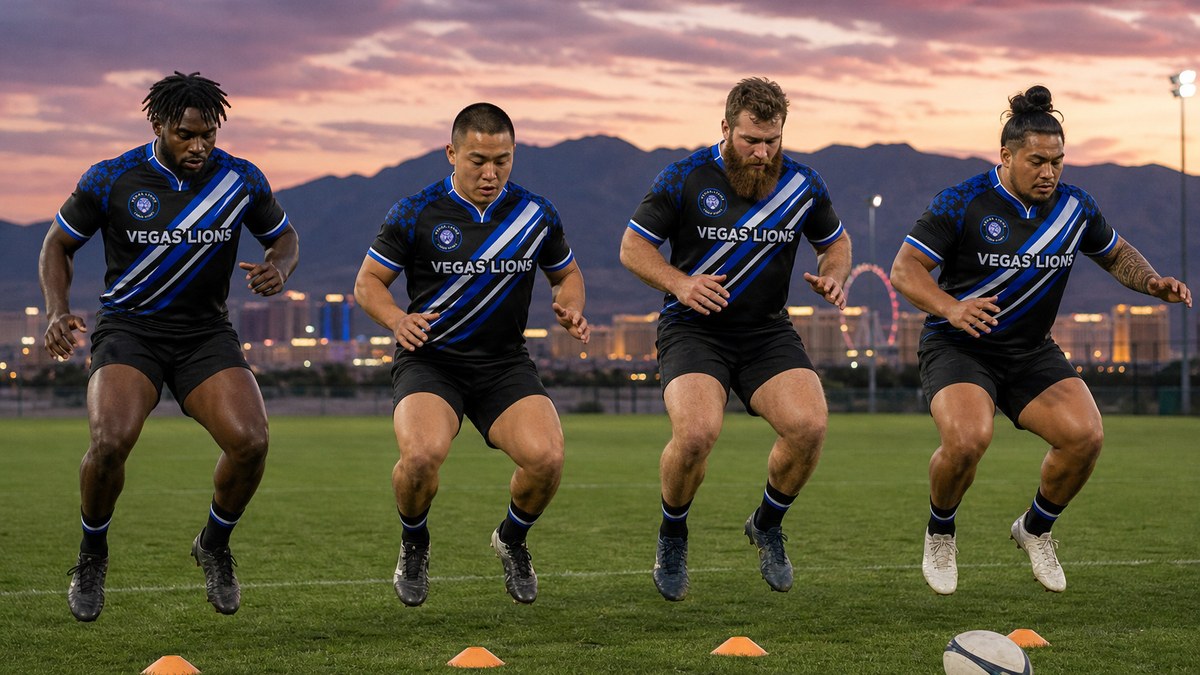
- Every session: warm up properly. Use a structured warm-up such as World Rugby's Activate, which includes balance, landing and strength exercises.
- Day 1, lower-body strength: squat variation, Romanian deadlift, split squat, plank. Finish with 3–4 sets of box jumps.
- Day 2, upper-body strength: bench press or push-ups, rows, overhead press, pull-ups or pulldowns, loaded carries.
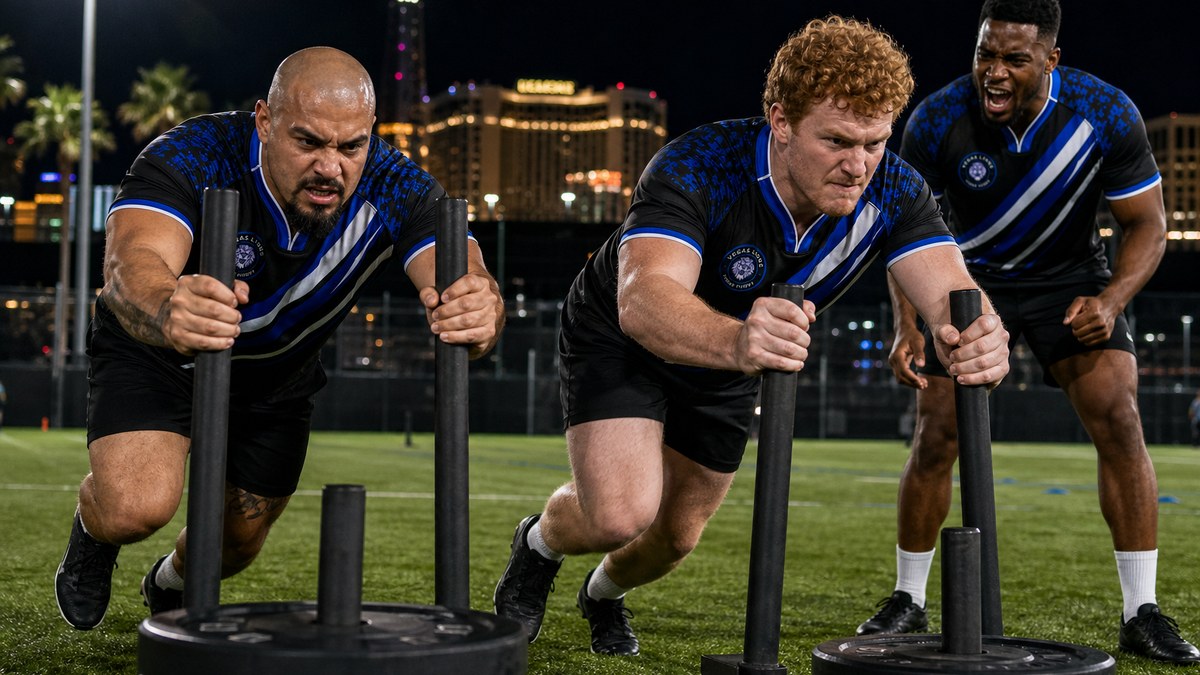
- Day 3, full-body power: broad jumps, medicine-ball throws, trap-bar deadlift, single-leg step-ups, sled pushes or carries.
- Progress gradually: add small amounts of load when you complete every rep with good form. Take at least one rest day between hard lower-body sessions.
In-season, most players cut volume and keep intensity, often lifting twice a week so they're fresh for training and matches. For conditioning ideas to pair with lifting, the Vegas Knights' guide to defensive line speed shows why repeat efforts matter as much as raw strength.
Is strength training safe for rugby players?
Resistance training is a well-established part of rugby preparation, and the injury-prevention evidence above shows it's one of the best things you can do for durability. Like any training, it needs to be done sensibly:
- Learn technique first under a qualified strength coach, especially for squats, deadlifts and Olympic lifts.
- Progress gradually. Small, regular increases beat big jumps in load.
- Use spotters and safety bars for heavy squats and bench presses.
- Manage total load. Lifting, running, skills and matches all add up. Fatigue raises injury risk.
- Get advice if you have an injury or a health condition. Check with a doctor or physiotherapist before starting a new program. This guide isn't medical advice.
Contact skills such as tackling, rucking and scrummaging should also be learned under a qualified coach, starting slowly and building up. APR's coaching clinic, May 28–31, 2027, is a good place to work on them.
Bring your power to the APR Games
The APR Games 2027 run Memorial Day weekend, May 29–31, in Las Vegas: 10-a-side rugby, two 20-minute halves under the lights. Men's Elite ($10,000 prize pool), Women's Social ($5,000) and Youth divisions. Player entry $299 includes a jersey, kit bag, at least three pool games and opening-night access.
Join the APR Games waitlistHow does strength training change for tens rugby?
The APR Games 2027 is played as 10-a-side rugby with two 20-minute halves. With fewer players on a full-size pitch, there's more space and more running between contacts. Strength and power still decide the collisions, but you'll need to repeat explosive efforts with less recovery. That means pairing your lifting with conditioning: sprints, repeated-effort drills and sled work.
The Vegas Lions are one of five founding franchises of American Pro Rugby, alongside the Vegas Kings, the Vegas Knights, the Vegas Blackjacks and Downtown Rugby. New to the game? Downtown's guide to touch rugby is an easy, non-contact way in.
Fueling your training matters too. Our partner Clann13 makes supplements for athletes. Talk to a qualified professional about what's right for you; a solid diet comes first.
Lions hunt together, and they train together. The players who get the most out of strength work are the ones who show up consistently with a training partner who holds them to good technique. Pride in your preparation is part of The Lions Code.
Frequently asked questions
How often should rugby players lift weights?
Many club players lift two to three times a week in the off-season and about twice a week in-season. The schools study behind World Rugby's Activate program recommended doing that program at least three times a week.
Does strength training reduce rugby injuries?
The evidence says yes. A 2014 meta-analysis found strength training reduced sports injuries to less than one-third, and World Rugby's Activate program is linked to 26–40% fewer soft-tissue injuries and 29–60% fewer concussions.
What is the difference between strength and power in rugby?
Strength is the maximum force you can produce. Power is how quickly you can produce it. Rugby collisions happen fast, so power is what shows up on the field, but you need strength first.
What are the best lifts for rugby players?
Squats, deadlift or hinge variations, single-leg exercises, presses, rows, pull-ups, loaded carries and explosive work such as jumps and medicine-ball throws.
How many reps should a beginner do?
Beginners often use rep ranges such as 3 sets of 8–12 and add load when they complete every rep with good technique. Percentages of a one-rep max are better suited to experienced lifters.
Should rugby players train to failure?
Not usually. Training to failure can be hard to manage and can prolong recovery, which competes with running, skills and matches.
Does stretching prevent rugby injuries?
The 2014 meta-analysis found stretching alone showed no beneficial effect on injury rates, while strength training had a large effect. Mobility still has its place in a warm-up.
What is World Rugby Activate?
A structured warm-up program developed by World Rugby with England Rugby and the University of Bath, combining balance, strength, plyometric and change-of-direction work, with versions for under-15s through adults.
Should rugby players lift weights during the season?
Yes. Most programs keep lifting in-season, usually with less volume and enough intensity to maintain strength, so players stay fresh for matches.
Do I need a coach to start strength training?
It's strongly recommended. A qualified strength coach can teach the big lifts safely and build a program around your position, schedule and any injury history.
Keep reading
Sources
- BJSM blog: Exercises to prevent sports injuries, on Lauersen, Bertelsen and Andersen's 2014 meta-analysis (BJSM 48:871–877), 20 July 2014
- University of Bath: World Rugby launches preventive exercise programme designed to reduce injuries, 11 September 2019
- World Rugby Passport: Conditioning for rugby, interventions to reduce injury risk
- World Rugby Passport: What is Activate?
- NSCA Coach: Using intensity based on sets and repetitions (Stone et al.), December 2025
- American Pro Rugby: APR Games 2027
This guide is general information, not individual coaching or medical advice. Learn strength exercises and contact skills under a qualified coach, progress gradually, and consult a doctor or physiotherapist before starting a new program if you have an injury or health condition.