
Home › Lions News › Training
TrainingRugby speed training: how to win the first 10 meters
Rugby players rarely get a long run-up. The race is usually won in the first few steps. Here's what the research says about acceleration in rugby, how it differs from top speed, and how coaches build it with sprints, sleds, strength and smart recovery.

Key facts at a glance
- Top speed comes late: international rugby players reached peak velocity between 30 and 40 m in a 50 m sprint (Barr, Sheppard and Newton, 2013)
- The first steps are different: ground contact was longest at the 3 m mark; players got faster mainly by shortening contact time and lengthening their stride
- Momentum is trainable: over two years, "speed appears to peak for players in their early 20s but sprint momentum appears to be more trainable" (Barr et al., 2014)
- The ball costs little: carrying the ball in one or two hands made only trivial to small differences (1–2%) in sprint times for 26 international players (Barr et al., 2015)
- Sleds aren't magic: in a 2025 randomized trial of youth rugby players, heavy sled sprints were no better than normal sprints for 30 m speed over four weeks (Zabaloy et al.)
- Protect the hamstrings: programs including the Nordic hamstring exercise cut hamstring injuries by up to 51% across 8,459 athletes (van Dyk et al., BJSM, 2019)
- Warm up right: World Rugby says its Activate program is linked to 26–40% fewer soft tissue injuries
Think about where speed actually shows up in a rugby match. A scrum-half snipes from the base of a ruck. A forward picks and goes. A defender leaves the line to shut down an attacker. A wing chases a kick and has to get going again after slowing down. None of those players starts from blocks, and few of them get 40 meters of open grass. What decides those moments is how quickly they can get moving. That is acceleration, and it is the most useful kind of speed a rugby player can train.
At the Vegas Lions, our identity is raw power and explosive strength training. We've already covered strength training for rugby, plyometrics for speed and power and how to run hard lines and win the collision. This guide connects them: how to turn strength and power into the first few explosive steps. It is general information, not a personal program. Sprint training is high-intensity work, so build it gradually and learn it under a qualified coach.
Why does acceleration matter more than top speed in rugby?
Sprinting has two broad phases. Acceleration is the phase where you are still picking up speed, with a forward lean and long ground contacts. Maximum velocity is when you are running upright at, or close to, your top speed. A 2013 study by Barr, Sheppard and Newton in the Journal of Australian Strength and Conditioning filmed 11 senior international rugby players during 50 m sprints at 400 frames per second. Their peak velocity came at the 33 m or 39 m mark, so top speed was reached between 30 and 40 meters.
That matters because rugby rarely gives players that much room. Most efforts are short, repeated and broken up by contact, rucks and changes of direction. Even outside backs, who reach the highest speeds, spend much of the game accelerating, decelerating and accelerating again. A 2022 study of semi-professional players in Frontiers in Sports and Active Living (Glaise et al.) notes that outside backs cover more sprint distance at higher velocities than other positions, and found that their in-game sprinting was closely linked to repeated-sprint ability: positions differ, but every player needs to get up to speed quickly, again and again.
In short: top speed matters for wings and fullbacks chasing a line break, but the first 10 meters matter for everyone.
Nobody in rugby gets a starter's pistol. You're getting up off the floor, coming out of a ruck or reading a pass. The player who wins the first three steps usually wins the moment. That's why we treat acceleration as a strength quality, not just a fitness one.
What does good acceleration technique look like?
Acceleration is mostly about pushing the ground backward hard and in the right direction. The Barr 2013 study found ground contact time was longest at the 3 m mark and that players got faster mainly by shortening their contact time and lengthening their stride, while stride rate stayed about the same. In practice, coaches usually cue a few things:
- Lean from the ankles. A straight line from head to heel, tilted forward, lets you push the ground backward rather than up. Bending at the waist leaks power.
- Push, don't reach. Early steps land under or slightly behind the hips. Reaching out in front acts like a brake.
- Drive the arms. Powerful, relaxed arm swing from the shoulder balances the legs and helps with rhythm. Hands move from hip to around face height.
- Rise gradually. The body comes up over roughly the first 10 to 20 meters. Popping straight up after one step wastes the lean.
- Short, powerful first steps, then longer ones. Let stride length build naturally as speed rises.
Rugby adds a few complications. Players start from split stances, from the ground, sideways, or while already jogging. They often carry the ball. The good news is that ball carrying costs very little: a 2015 study by Barr, Sheppard, Gabbett and Newton in the International Journal of Sports Science and Coaching timed 26 international players over 40 m with the ball in one hand, two hands or no ball, and found only trivial to small differences of 1–2%. The same study found backs were faster than forwards at every split, by 0.04 to 0.08 seconds.
| Sprint phase | Rough distance | What it looks like | Where it shows up in rugby |
|---|---|---|---|
| Start / first steps | 0–5 m | Big forward lean, long ground contacts, powerful arm drive | Picking and going, leaving the defensive line, getting up off the ground |
| Acceleration | 5–20 m | Gradual rise, longer strides, contact time getting shorter | Hitting a hole, chasing a kick, scrum-half sniping |
| Transition | 20–30 m | Nearly upright, speed still rising | Supporting a break, covering defense |
| Maximum velocity | 30–40 m and beyond | Upright, short ground contacts, near top speed | Wings and fullbacks in open field, long chases |
Distances are approximate and vary with the player and how they start; the 30–40 m peak comes from the elite rugby data above.
Is speed or momentum more important for rugby players?
In a collision sport, how fast you are going is only half the story. Momentum is mass multiplied by velocity, and a heavier player arriving at the same speed hits harder and is harder to stop. Barr, Sheppard, Gabbett and Newton followed elite rugby union players in a 2014 paper in the Journal of Strength and Conditioning Research. They tested 38 senior and 31 junior players over 40 m with 10 m splits, then tracked 12 juniors and 15 seniors for two years. Their conclusion: "Speed appears to peak for players in their early 20s but sprint momentum appears to be more trainable."
That fits the Lions' philosophy. If you can add useful muscle while keeping or improving your acceleration, you become a more dangerous carrier and a more effective defender. That is why acceleration work and heavy strength training belong in the same plan, not in competition with each other.
Power is in The Lions Code for a reason. Getting bigger only helps if you can still move it. We want players who arrive fast and arrive heavy. Strength builds the engine; acceleration work teaches you to use it.
How do you train acceleration for rugby?
There's no single best method, but most good programs share a few principles. Here's how many strength and conditioning coaches approach it. Treat it as a general framework, not a prescription for you.
1. Sprint short, sprint fresh
Acceleration is a high-quality skill. Short sprints of about 5 to 20 meters, done with full effort and plenty of rest between reps, train it best. If you are gasping and slowing down, you're doing conditioning, not speed work. Conditioning matters too, but it's a different session; the Vegas Knights' guide to conditioning for repeat efforts covers that side.
2. Use rugby starts
Mix in the starts you actually use in a game: split stance, three-point, lying face down, getting up from your back, a jog-in, a sideways shuffle into a sprint, or reacting to a coach's call or a dropped ball. Reaction and decision-making are part of game speed.
3. Build strength and power in the gym
Acceleration demands high forces in short contact times. Lower-body strength (squats, deadlift variations, split squats) and power work (jumps, bounds, Olympic lift variations if well coached) give you more force to put into the ground. Our plyometrics guide explains how jump training fits in.
4. Add resisted sprints carefully
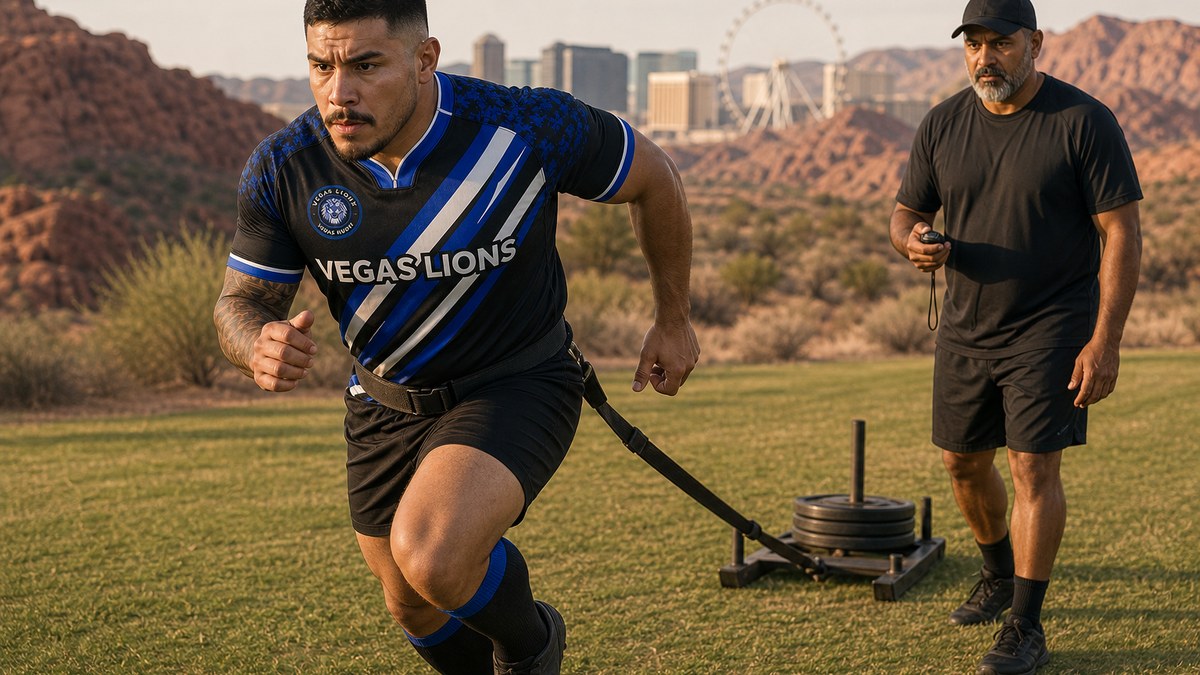
Sled pushes and pulls are popular in rugby, and they look the part. The evidence is more mixed than the hype. A randomized controlled trial published in the Journal of Human Kinetics in 2025 (Zabaloy and colleagues) split under-19 academy rugby union players into groups doing either unresisted sprints or heavy sled sprints at 50% of body mass, three times a week for four weeks. In the 24 players analyzed, the unresisted group improved its 0–30 m time from 4.43 to 4.34 seconds, and the authors found "no significant differences" between the two approaches on any of their main measures. Sleds can be a useful tool for practicing forward lean and powerful pushes, but normal, well-coached sprinting remains the foundation.
5. Bring in the ball and the decision
Once mechanics are solid, add a ball, a pass and a defender. Acceleration onto a flat pass, or out of a ruck, is where speed turns into rugby. This links directly to running hard lines and arriving at the defense at pace.
What does a weekly acceleration session look like?
The example below shows how a coach might structure one acceleration-focused session in the off-season or pre-season for an adult player who is already used to sprinting. It's an illustration of the principles, not a plan for you. Volumes, rest and progression should be set by a qualified coach who knows your training history.
| Block | Example content | Purpose |
|---|---|---|
| Warm-up | World Rugby Activate or a similar structured warm-up, then build-up runs at 60–80% effort | Raise temperature, prepare muscles and tendons, reduce injury risk |
| Technique drills | Wall drills, marching and skipping with a forward lean, arm-action drills | Groove body position and push direction |
| Short sprints | A handful of 10 m sprints from varied rugby starts, full rest between reps | High-quality acceleration |
| Optional resisted work | A few light-to-moderate sled sprints over short distances | Reinforce lean and pushing force |
| Game-specific | Accelerate onto a pass or out of a ruck, then beat a cone or a passive defender | Transfer to rugby situations |
| Strength (same day or separate) | Squat or split-squat variation, a hip-hinge, Nordic hamstring exercise | Force production and hamstring robustness |
Speed sessions usually go early in the week or early in the session, when players are fresh. Many coaches avoid hard sprinting the day after a heavy contact session or a match. If you're planning a full pre-season, the Vegas Kings' 6-week pre-season conditioning plan shows how speed, conditioning and strength can fit together across the weeks.
How do you avoid hamstring injuries when sprinting?
Sprinting is one of the most common ways rugby players hurt their hamstrings, so speed training has to come with injury prevention built in. A few evidence-based habits help:
- Nordic hamstring exercise. A 2019 systematic review and meta-analysis in the British Journal of Sports Medicine (van Dyk, Behan and Whiteley) pooled 15 studies and 8,459 athletes. Programs that included the Nordic hamstring exercise reduced hamstring injuries by up to 51% (risk ratio 0.49). Build up the volume slowly; it causes a lot of soreness at first.
- Warm up properly. World Rugby's free Activate program has adult and youth versions and a match-day module. World Rugby says it is linked to 26–40% fewer soft tissue injuries and 29–60% fewer concussions. In one adult trial of 81 clubs (Attwood and colleagues, 2017), the intervention group saw a 40% reduction in lower-limb injuries and a 60% reduction in concussions.
- Sprint regularly. Players who never run fast in training are not prepared for the speeds they hit in matches. Regular, controlled exposure to fast running is part of injury prevention, not just performance.
- Progress gradually and respect fatigue. Big jumps in sprint volume, sprinting when exhausted, or sprinting cold are common problems. Stop a session if something feels wrong.
Any pain, tightness that doesn't settle or a previous injury needs proper assessment. See a doctor or physiotherapist before returning to sprinting after a hamstring injury.
How is acceleration different for forwards and backs?
Everyone needs to accelerate, but the context changes by position. If you're not sure what each number does, the Vegas Kings' guide to rugby positions breaks it down.
- Front row and locks mostly accelerate over very short distances: off the line in defense, into a ruck, or into a pick-and-go. Mass makes momentum valuable here, so strength plus a sharp first two or three steps pays off.
- Back-rowers need repeated short accelerations around the field, to the breakdown and in cover defense. Speed endurance matters more for them than for most forwards.
- Scrum-halves and fly-halves accelerate from the base of rucks and to support breaks. Reaction and change of direction are key.
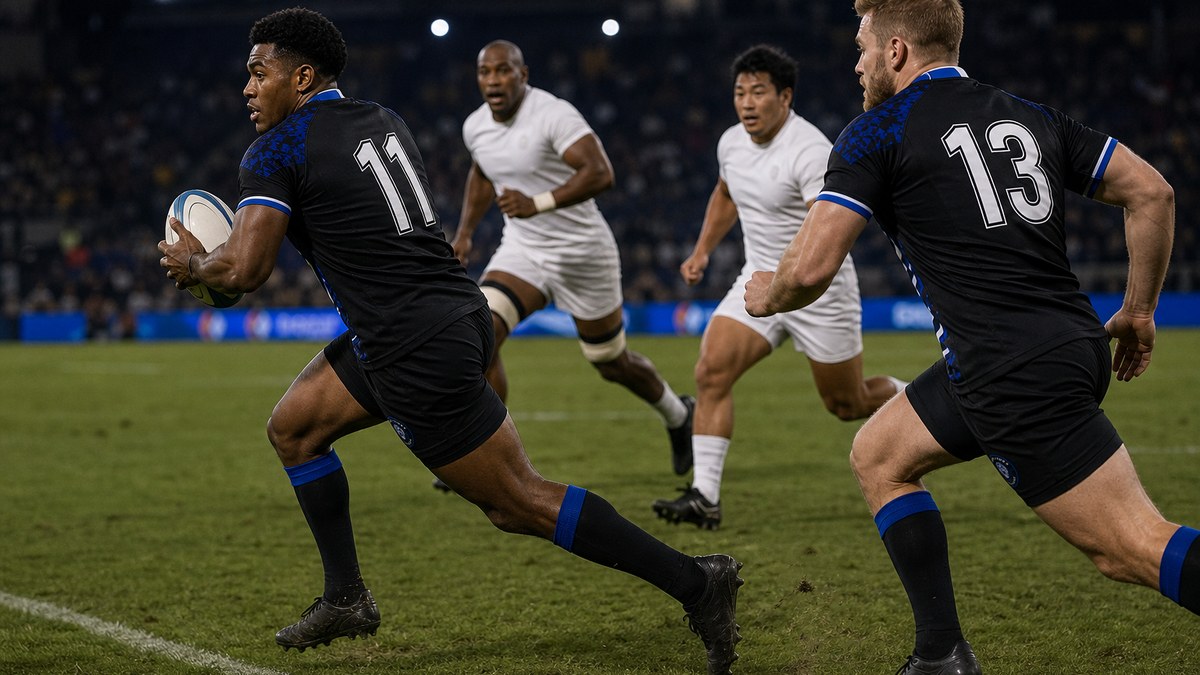
- Centers, wings and fullbacks need both: explosive acceleration onto the ball and genuine top speed when a gap opens. Outside backs hit the highest speeds in matches.
Getting up off the ground and back into the game is a form of acceleration too. Defenders train it constantly; the Knights' safe tackling guide and the Vegas Blackjacks' guide to rucking show how much of rugby happens in the seconds after contact.
Props don't need to win a 40 m race, but they do need to beat the man opposite to the next ruck. Wings need both gears. Train the speed your position actually uses, and train all of it like it matters, because in a match it does.
Does acceleration matter more in 10-a-side rugby?
The APR Games 2027 are 10-a-side, with two 20-minute halves, held Memorial Day weekend, May 29–31, in Las Vegas. With fewer defenders covering the same width of field, there is more space, so one quick burst through a gap can turn into a try. Defense has to get off the line fast and cover more ground. And because matches are shorter and more intense, the ability to repeat accelerations without fading matters. It's a format that rewards exactly what this guide is about.
Under the new World Rugby law wording approved on 17 June 2026, community competitions can lower the tackle height to the waist or the base of the sternum from 1 July 2026, and Law 14.1 now says the ball carrier must enter the tackle safely. Accelerating into contact means staying in control of your body height; never dip your head into a tackler. Rules for the APR Games will be confirmed with player registration.
Bring your speed to the APR Games
The APR Games 2027 run Memorial Day weekend, May 29–31, in Las Vegas: 10-a-side rugby, two 20-minute halves under the lights. Men's Elite ($10,000 prize pool), Women's Social ($5,000) and Youth divisions. Player entry $299 includes a team jersey, kit bag, at least three pool games and opening-night access.
Join the APR Games waitlistWant to learn sprint mechanics and rugby skills in person? The APR coaching clinic runs May 28–31, 2027, in Las Vegas. New to the game entirely? Downtown Rugby's guide to starting rugby as an adult is the place to begin. The Lions are one of five founding franchises of American Pro Rugby; meet the others on the APR teams page, follow the wider game on APR's rugby news and pick up training gear at the APR merch store.
Fast sessions are demanding, and recovery starts with sleep and good food. Our partner Clann13 makes supplements for athletes; talk to a qualified professional about whether any supplement is right for you. And if you're visiting Las Vegas for the Games, our partner Luna Appleton covers where to stay, eat and celebrate in town.
Want one skill broken down and a strength block every week? Join The Breakdown, APR's free weekly newsletter.
Frequently asked questions
What is the most important type of speed in rugby?
For most players it is acceleration, the ability to get from a standstill or slow jog up to speed in the first 5 to 20 meters. Elite rugby players do not reach top speed until 30 to 40 meters, and most match efforts are shorter than that.
How far should rugby players sprint in acceleration training?
Acceleration work usually uses short sprints of roughly 5 to 20 meters at full effort with plenty of rest, so every rep is high quality. Longer sprints train top speed, and short rests turn speed work into conditioning.
Can you get faster at rugby as an adult?
Yes, although raw speed tends to improve less after the early twenties. Research on elite rugby union players found sprint momentum, which combines mass and speed, kept improving with training more than speed alone.
Does sled training make rugby players faster?
It can be a useful tool, but it is not clearly better than normal sprinting. A 2025 randomized trial in youth rugby players found no significant difference between heavy sled sprints and unresisted sprints over four weeks.
Does carrying the ball slow you down?
Only slightly for skilled players. A study of 26 international players found carrying the ball in one or two hands changed sprint times by only around 1 to 2 percent.
What is good acceleration technique?
Lean forward from the ankles, push the ground backward with short powerful steps under the hips, drive the arms and rise gradually over the first 10 to 20 meters instead of standing up straight away.
How do I avoid hamstring injuries when sprinting?
Warm up properly, sprint regularly so your body is used to fast running, build volume gradually and include the Nordic hamstring exercise. Programs with the Nordic hamstring exercise cut hamstring injuries by up to 51 percent in a large meta-analysis.
How often should rugby players do speed training?
Many programs include one or two short acceleration sessions a week, done when players are fresh and away from heavy contact days. The right amount depends on the season and your training history, so plan it with a qualified coach.
What is World Rugby Activate?
Activate is World Rugby's free warm-up and physical preparation program for training and matches, with adult and youth versions. World Rugby says it is linked to 26 to 40 percent fewer soft tissue injuries and 29 to 60 percent fewer concussions.
Is acceleration important for forwards?
Yes. Forwards rarely sprint far, but they constantly accelerate over a few meters into rucks, carries and defense. Because they are heavier, a quick first few steps gives them a lot of momentum.
Keep reading
Sources
- Barr MJ, Sheppard JM, Newton RU. Sprinting kinematics of elite rugby players. Journal of Australian Strength and Conditioning 21(4):14–20, 2013
- Barr MJ, Sheppard JM, Gabbett TJ, Newton RU. Long-term training-induced changes in sprinting speed and sprint momentum in elite rugby union players. Journal of Strength and Conditioning Research 28(10):2724–2731, 2014
- Barr MJ, Sheppard JM, Gabbett TJ, Newton RU. The effect of ball carrying on the sprinting speed of international rugby union players. International Journal of Sports Science and Coaching 10(1):1–9, 2015
- Zabaloy S, et al. A randomized controlled trial of unresisted vs. heavy resisted sprint training programs in youth rugby union players. Journal of Human Kinetics 95:199–214, 2025
- van Dyk N, Behan FP, Whiteley R. Including the Nordic hamstring exercise in injury prevention programmes halves the rate of hamstring injuries: a systematic review and meta-analysis of 8459 athletes. British Journal of Sports Medicine 53(21):1362, 2019
- Glaise P, et al. Influence of repeated-sprint ability on the in-game activity profiles of semiprofessional rugby union players according to position. Frontiers in Sports and Active Living 4:857373, 2022
- World Rugby Passport: Activate, a physical preparation resource proven to reduce injury risk in rugby (and Activate research summary)
- World Rugby: World Rugby lowers legal tackle height in community rugby, 17 June 2026
- American Pro Rugby: APR Games 2027
This guide is general information, not individual coaching or medical advice. Learn sprint technique and build training volume gradually under a qualified coach, and consult a doctor or physiotherapist before training after an injury or if you have any health concerns.