
Home › Lions News › Rugby 101
Rugby 101The rugby carry: how to run hard lines and win the collision
Every attack in rugby comes down to someone carrying the ball into a defender. Here's what the research says separates a winning carry from a lost one, how to run a hard line, how to keep the ball, and how to carry safely under the new lower tackle height.
Key facts at a glance
- What wins carries: speed at the line, a late change of direction or straightening, leg drive, body mass and support from team-mates (Woodhouse et al., 2024)
- Fend + leg drive: both raised the odds of a tackle break or offload in the 2014 Six Nations and Rugby Championship (Hendricks et al., 2017)
- Keeping the ball: falling sideways and actively placing the ball was the strongest ball-carrier predictor of retaining possession at the ruck
- Safety: in professional rugby, ball carriers had about 0.54 head injury assessments per 1,000 tackles, versus 1.40 for tacklers (Tucker et al., BJSM, 2017)
- New law: World Rugby approved a lower community tackle height (waist or base of sternum) on 17 June 2026, effective 1 July 2026
- Ball-carrier duty: the updated Law 14.1 says the ball carrier has a responsibility to enter the tackle safely
- Golden rule: evade first, two hands on the ball, eyes up, never lead with the head
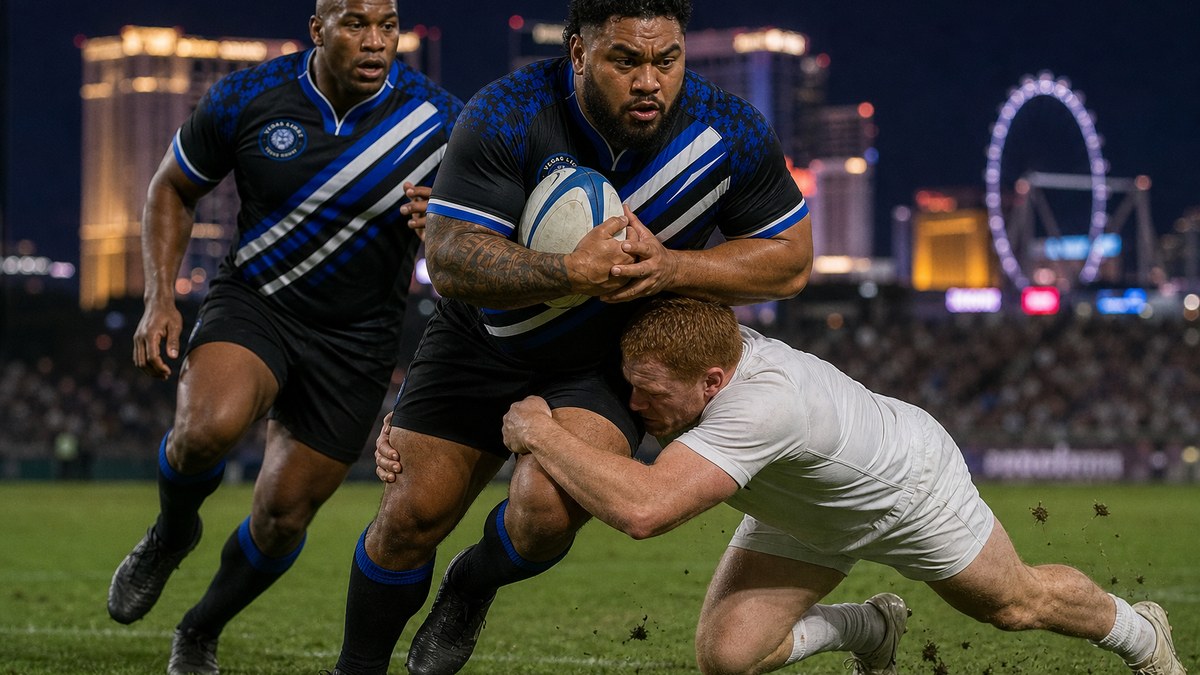
Watch any match closely and you'll see that most of the game is a series of carries. A forward picks up from the base of a ruck and runs at the fringe defense. A center takes a flat pass and hits a gap. A wing chases a kick and fights for an extra meter. Each of those is a rugby carry, and the team that wins more of those collisions usually controls the game. It's the purest test of physicality in the sport, which is why it sits at the heart of how the Vegas Lions want to play.
We've already covered the engine behind a good carry: strength training for rugby and plyometrics for speed and power. This guide is about using that power with a ball in your hands. It's general information to help you understand the skill. Contact technique has to be learned and practiced live, step by step, under a qualified coach.
What is a carry in rugby?
A carry is any time a player runs with the ball toward the opposition. In stats it usually means a run that ends in contact or a break, and analysts track things like meters made, post-contact meters, tackle breaks, offloads and whether the carrier "won" the collision by getting over the gainline. The gainline is the imaginary line across the field where the last breakdown or set piece happened; crossing it puts your team on the front foot and the defense on the back foot.
A carry has three parts, and good carriers do all three well:
- Before contact: the line you run, your speed and your footwork. This is where you choose whether to beat the defender or meet them on your terms.
- The contact itself: body position, ball security, the fend and leg drive.
- After contact: staying on your feet to offload, or going to ground and placing the ball so your team keeps it.
A carry isn't a battering ram. The best carriers we've watched beat half the defender before they ever touch him: the angle, the late step, the speed. Contact is the last part of the carry, not the whole of it.
What makes a carry successful? What the research says
Coaches have talked about "dominant carries" for years. Over the past decade, sports scientists have started measuring them, mostly by coding video of elite matches frame by frame.
- Hendricks and colleagues (2017), in the Journal of Sports Sciences, analyzed every match of the 2014 Six Nations and 2014 Rugby Championship: 4,479 tackle events and 2,914 rucks. For ball carriers, fending during contact made a tackle break or offload far more likely (relative risk 4.5 in the Six Nations and 5.1 in the Championship). Leg drive after contact also raised the odds of a positive outcome in both tournaments. At the ruck, falling sideways and actively placing the ball was the strongest ball-carrier predictor of keeping possession.
- Woodhouse and colleagues (2024), also in the Journal of Sports Sciences, coded collisions from 16 international matches played by a top-two ranked women's team. Winning carries were predicted by a combination of speed at the line, change of direction or straightening, leg drive, body mass and team-mate assistance. They also linked small gains (around 2%) in squat, jump and sprint measures with better technical outcomes in contact.
Put simply: speed, a smart line, leg drive and support win carries. Mass helps, but it isn't everything, and every one of those other factors can be trained.
| Carry factor | What it looks like | Evidence | How to train it |
|---|---|---|---|
| Speed at the line | Arriving at full pace, not slowing to brace | Predicted winning carries (Woodhouse 2024) | Acceleration work, plyometrics, catching at pace |
| Line and late footwork | Straightening or stepping late to hit a shoulder or gap | Change of direction predicted winning carries | Evasion drills, 2-v-1s, footwork ladders |
| Leg drive | Short, fast steps through and after contact | Raised tackle-break and offload odds (Hendricks 2017) | Contact-shield and sled drives, squats |
| Legal fend | Straight arm to the tackler's chest or shoulder | Large increase in tackle breaks and offloads | Coached fend drills with pads; never to the head |
| Ball security | Two hands before contact, ball away from the tackler | World Rugby coaching guidance | Grip and carry drills, ball-ripping games |
| Ball placement | Fall sideways, long placement back toward support | Strongest predictor of ruck retention | Go-to-ground and place drills on mats |
| Support | A team-mate arriving close to drive or clean | Team-mate assistance predicted winning carries | Unit drills, pod play, communication |
How do you run a hard line?
A "hard line" is a run straight at, or slightly across, the defense with real intent, often onto a short pass. Its job is to fix defenders, win the gainline or punch a hole. The tricky part is that running straight at someone without a plan just invites a big tackle. Good hard lines have a few things in common:
- Arrive at speed. Hold your depth so you can hit the pass at pace rather than standing flat and starting from still. The research above is clear that speed into contact matters.
- Aim at space, not bodies. World Rugby's open-field guidance tells ball carriers to "aim for the space around the defender, not the defender's body." Run at a defender's inside or outside shoulder, or the gap between two defenders, so they can't square up to you.
- Change the angle late. A short step or a late "straightening" just before contact moves the tackler off balance. You want them reaching, not set.
- Eyes up, ball visible. Keep your head up and the ball in two hands for as long as possible. That keeps the pass alive and stops the defense from reading your intent.
- Know your support. A hard line only works if someone is running off you. Call for it, and know who's coming.
Defenses fight this with line speed and organization. If you want to understand what you're running into, the Vegas Knights' guide to blitz, drift and line speed explains exactly how defenders try to shut down a carrier's time and space.
How do you win the collision safely?
When contact is coming and you can't evade it, the goal is to win the contact without risking your head or your opponent's. World Rugby's Rugby Ready advice for the ball carrier going into contact boils down to:
- Get into a strong, stable position before contact. Hips and shoulders lower than your opponent's, back flat, head up and neutral, eyes open.
- Keep the ball in both hands until the last moment, then secure it away from the tackler.
- Make the tackler come in from the side rather than head-on, by stepping or turning your shoulder slightly.
- Keep your legs driving. Short, powerful steps keep your momentum and give your support time to arrive.
- Pass out of the contact if you can.
The fend deserves a special note. It's one of the most effective tools a carrier has, but a 2018 study in the Journal of Sports Sciences by Tierney and colleagues looked at 74 tackles that led to a tackler's head injury assessment in elite rugby and found that fending into contact was linked to a higher risk in front-on, upper-body tackles. In 67% of those cases, the fending arm hit the tackler's head. The authors recommended teaching safe fending: a straight arm to the chest or shoulder, never the head or neck. That's how we teach it, too.
Low, square and driving. That's the Lions' carry. You win the collision with your legs and your body height, not your head. If you drop your head into a tackle, you're not being brave; you're giving the defender your neck. Eyes up, every time.
How does the new tackle height change carrying?
On 17 June 2026, the World Rugby Council in Dublin approved lowering the legal tackle height in community rugby. From 1 July 2026, unions can set the sanction line at either the waist or the base of the sternum. World Rugby said the change followed two years of trials by ten national unions and more than 150,000 tackles studied, which showed a lower tackle height reduced upright tackles, "the most likely to cause avoidable head impacts." Elite rugby keeps the shoulder line for now, with a lower-height trial at the Junior World Championship in Georgia from 27 June 2026.
For carriers, the updated law wording matters as much as the height itself:
- Law 14.1 now states that the ball carrier has a responsibility to enter the tackle safely.
- Competitions using the optional "Game On" provisions can penalize a ball carrier in open play who significantly lowers their height before making dangerous contact with a tackler. The note excludes low-speed pick-and-go actions and players dipping to score.
The practical message: run with good, controlled body height so you can absorb a lower tackle and keep driving, but don't "dip" suddenly into a tackler with your head. Check which version your league uses; in the US, that's set by USA Rugby and your competition organizer, and rules for the APR Games will be confirmed with player registration.
What happens after contact: offload or go to ground?
A carry doesn't end at the hit. What you do in the next second decides whether your team keeps the ball. World Rugby's coaching notes split it into three situations:
- Held and taken to ground (tackled): try to pass to support as you land. If you can't, place the ball back toward your team so a ruck can form.
- Taken to ground but not held: you haven't been tackled. Get up and keep playing.
- Held but still on your feet: keep a strong position and drive your legs, look for arriving support and offload if you can. If a team-mate binds on, it becomes a maul.
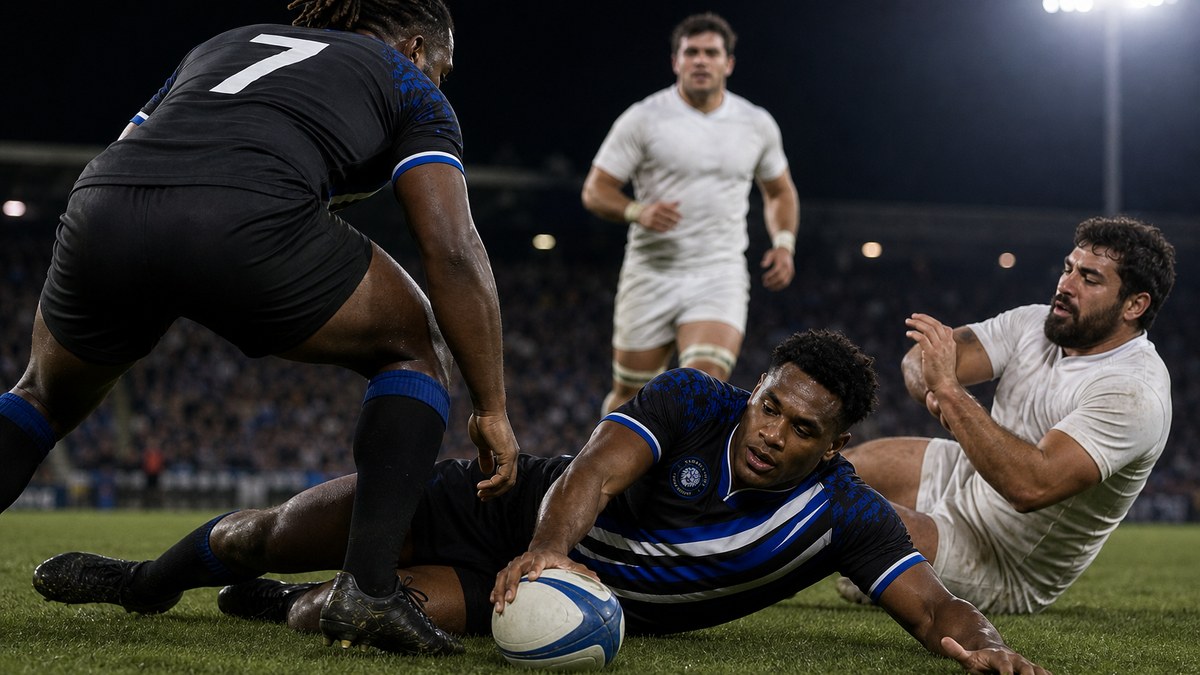
The Hendricks study found that falling sideways and actively placing the ball was the single biggest thing a carrier could do to keep possession at the ruck (relative risk 4.0 in the Rugby Championship, 2.2 in the Six Nations). Twist as you go down, land on your side rather than flat on your front, and place the ball with a long arm back toward your support. Then it's over to the cleaners. The Vegas Blackjacks' rucking guide covers how support players win that contest.
How do you train carrying skills?
Carrying is part skill, part physical quality. Here's how many coaches build it, from safe to live. It's a general progression, not a personal prescription; a qualified coach should decide when you're ready to move up.
- Ball security and footwork, no contact: two-handed carries, switching the ball to the far arm, side steps and swerves around cones. Ball-ripping games where a partner tries to strip the ball teach grip.
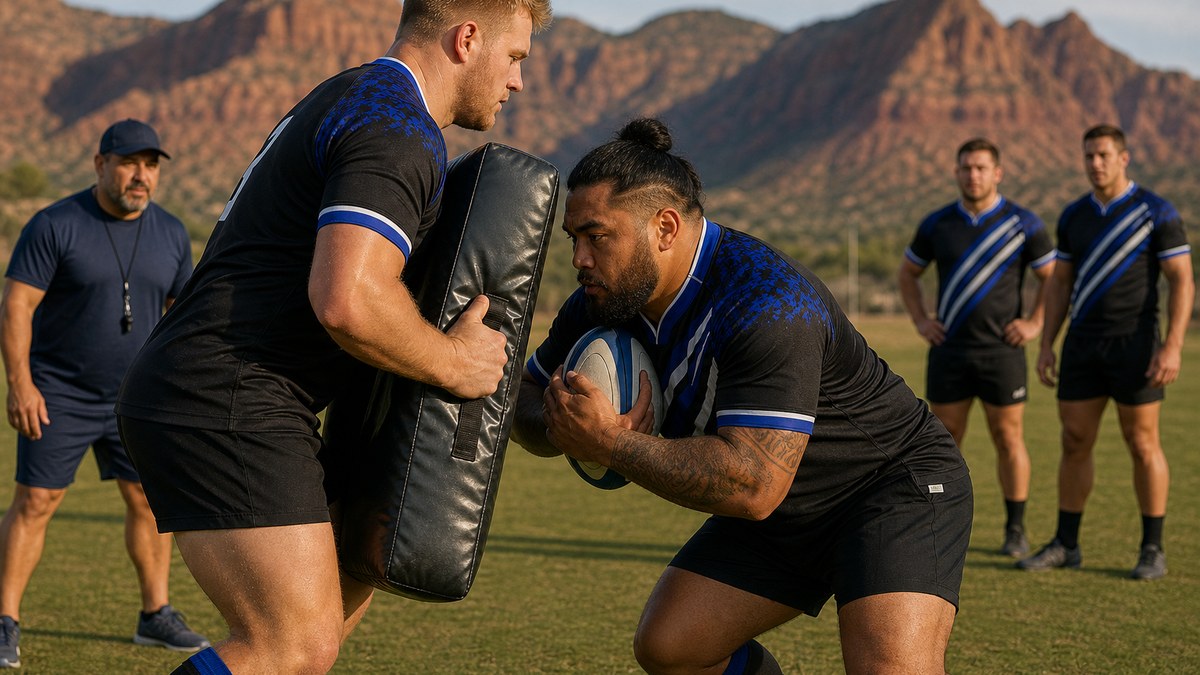
- Body position on pads: walk, then jog, into a contact shield with a low, square position and short driving steps, as in the image above. The focus is head up, back flat, ball tight.
- Go-to-ground and place: on mats or soft grass, practice falling sideways and placing the ball from your knees, then from a walk.
- Fend and evasion with pads: straight-arm fends into a pad held at chest height, plus late steps against a passive defender.
- Controlled live work: 1-v-1 or 2-v-1 in narrow channels at reduced speed, matched for size and experience, with a coach watching technique.
The physical side comes from the gym and the track: lower-body strength for leg drive, sprint work for speed at the line and plyometrics for explosiveness. If you're getting ready for a season, the Vegas Kings' 6-week pre-season conditioning plan ties those pieces together. Defenders train the other side of this contest, and the Knights' guide to tackling safely is worth reading so you understand what a good tackler is trying to do to you.
New to contact altogether? Downtown Rugby's guide to starting rugby as an adult walks through how beginners are introduced to contact safely. The APR coaching clinic, May 28–31, 2027, in Las Vegas is a good place to learn it in person.
"Explosive force in every contact" is the Power line in The Lions Code. But force without control is just a collision. We train the carry in that order: control, then position, then power. The pride that carries together, conquers together.
Carry it at the APR Games
The APR Games 2027 run Memorial Day weekend, May 29–31, in Las Vegas: 10-a-side rugby, two 20-minute halves under the lights. Men's Elite ($10,000 prize pool), Women's Social ($5,000) and Youth divisions. Player entry $299 includes a team jersey, kit bag, at least three pool games and opening-night access.
Join the APR Games waitlistWhy do carries matter even more in tens?
The APR Games 2027 are 10-a-side, with two 20-minute halves. With fewer defenders across the same field, there's more space, so a carrier who wins the first collision or beats one defender often finds open grass behind. That rewards exactly what the research highlights: speed at the line, a smart angle and quick support. It also means every player, forward or back, has to be comfortable carrying. And because a turnover in space can be punished fast, ball security and placement count double.
The Lions are one of five founding franchises of American Pro Rugby; meet every team on the APR teams page and keep up with the wider game on APR's rugby news. Gear up for training at the APR merch store.
Carrying is hard on the body, so recovery and fueling matter. Our partner Clann13 makes supplements for athletes; talk to a qualified professional about what's right for you, and get the basics of food and sleep right first. Building something of your own off the field? Our partner In Too Win works with Las Vegas businesses and investment.
Want one skill broken down and a strength block every week? Join The Breakdown, APR's free weekly newsletter.
Frequently asked questions
What is a carry in rugby?
A carry is any run with the ball toward the opposition, usually ending in contact, a tackle break or a pass. Teams track carries, meters gained, post-contact meters and whether the carrier crossed the gainline.
What makes a dominant carry?
Elite match analysis links winning carries to speed at the line, a late change of direction or straightening, leg drive after contact, body mass and quick support from team-mates.
How do you run a hard line in rugby?
Hold your depth so you arrive at speed, aim at a defender's shoulder or the gap between defenders rather than their chest, change the angle late, keep your eyes up and the ball in two hands, and make sure support is running off you.
Should a ball carrier lower their body before contact?
Carry with a strong, controlled body height and your head up. Under the 2026 law wording the ball carrier must enter the tackle safely, and some competitions penalize carriers who suddenly drop their height into dangerous contact with a tackler.
Is the fend legal in rugby?
Yes. A hand-off or fend with a straight arm to the tackler's chest or shoulder is legal. Fending to the head or neck is dangerous, and research has linked fends that hit the tackler's head to head injury assessments.
How do you keep the ball when you are tackled?
Try to pass as you go down. If you can't, fall sideways rather than flat, and place the ball with a long arm back toward your support. Studies of international rugby found this was the strongest carrier action for keeping possession.
What is leg drive in rugby?
Leg drive means keeping short, powerful steps going through and after contact. It helps carriers break tackles, gain meters and buy time for support, and it is built with strength training and contact-shield drills.
What is the new tackle height in community rugby?
World Rugby approved lowering the community tackle height on 17 June 2026. From 1 July 2026 unions can set it at the waist or the base of the sternum. Elite rugby keeps the shoulder line for now.
Are ball carriers or tacklers more at risk of head injury?
Tacklers. A study of 611 head injury assessments in professional rugby found about 1.40 per 1,000 tackles for tacklers and 0.54 per 1,000 tackles for ball carriers. Good carrying technique still matters for both players' safety.
Do backs need to carry as well as forwards?
Yes. Forwards often carry close to the ruck and backs carry in wider channels, but everyone needs a secure carry, good body position and safe ball placement, especially in 10-a-side rugby.
Keep reading
Sources
- World Rugby: World Rugby lowers legal tackle height in community rugby, 17 June 2026
- World Rugby Passport: Community tackle height law wordings approved, June 2026
- World Rugby Passport: Rugby Ready, open field play (ball carrier into contact)
- Hendricks S, et al. Technical determinants of tackle and ruck performance in International rugby union. Journal of Sports Sciences 36(5):522–528, 2018 (online 2017)
- Woodhouse LN, Bennett M, Tallent J, Patterson SD, Waldron M. Technical collision behaviours and physical characteristics in world-class, international female rugby players. Journal of Sports Sciences, 2024
- Tierney GJ, Denvir K, Farrell G, Simms CK. Does ball carrier technique influence tackler head injury assessment risk in elite rugby union? Journal of Sports Sciences 37(3):262–267, 2019 (online 2018)
- Tucker R, et al. Risk factors for head injury events in professional rugby union: a video analysis of 464 head injury events. British Journal of Sports Medicine 51(15):1147–1151, 2017
- American Pro Rugby: APR Games 2027
This guide is general information, not individual coaching or medical advice. Learn carrying and all contact skills step by step under a qualified coach, with players matched for size and experience, and consult a doctor or physiotherapist before returning to contact after an injury.