
Home › Lions News › Training
TrainingIn-season strength training for rugby: how to stay strong all season
Pre-season builds the engine. The season is where most players quietly lose it. Here's what the research says about in-season strength training for rugby, how often players lift once the games start, and why holding your squat may matter for your tackling by round 15.
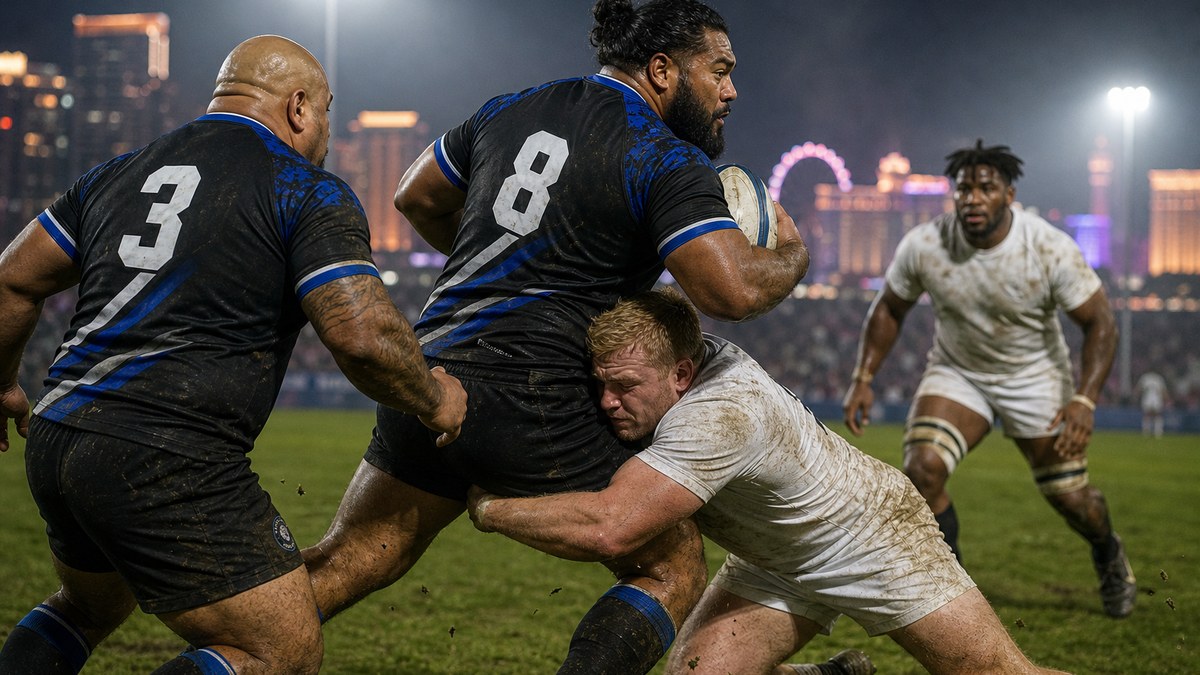
Key facts at a glance
- World Rugby guidance: "Two resistance training sessions a week is achievable in-season," with low volume and high intensity enough to maintain strength and power (World Rugby Passport, Advanced Conditioning for Rugby)
- Detraining: across 27 studies of rugby union, rugby league and American football players, strength could be maintained for up to 3 weeks without training; after that, decay rates increased (McMaster et al., Sports Medicine, 2013)
- Tackling link: in 12 semiprofessional rugby league players, change in 1RM squat over the first 15 rounds of the season was related to change in tackling ability (rs = 0.70; Speranza et al., 2017)
- Late-season dip: in 16 English Premiership players, early rate of force development fell 6–9% from mid to end of season, while peak force and power were maintained (Gannon et al., 2016)
- Frequency matters: professional soccer players who lifted once a week in-season kept their strength and sprint gains; those who lifted once every second week lost both (Rønnestad et al., 2011)
- Load, not just rest: "Excessive and rapid increases in training loads" are linked to many soft-tissue injuries, but cutting workloads isn't always the safest answer (Gabbett, BJSM, 2016)
Every rugby season follows the same pattern. Players arrive for pre-season, lift hard for six to ten weeks, test well and feel strong. Then the fixtures start. Team runs, video, travel and recovery fill the week, bodies get banged up, and the weights room becomes the first thing to go. By the business end of the season, many players are weaker than when they started, right when the games matter most.
At the Vegas Lions, raw power is our identity. We've already covered strength training for rugby, plyometrics, acceleration and leg drive in contact. All of that work is wasted if it disappears by midseason. This guide covers the research on in-season strength training for rugby: why strength fades, how often players typically lift once the season starts, how sessions change and how to fit them around games. It's general information, not a personal program. Your coach knows your schedule, your history and your body, so plan the details with them.
Why does in-season strength training matter in rugby?
Strength isn't a bank balance that stays put once you've earned it. World Rugby's own coaching material puts it plainly: "Strength and power adaptations do not last indefinitely," and if resistance training is stopped or drastically reduced in-season, strength and power "can be expected to decrease." Its stated aim for in-season lifting is "at best to continually improve, and at least to maintain strength and power levels over the course of the season."
That matters because rugby is a collision sport played for months. The tackle, the carry, the ruck, the scrum and the maul all reward the player who can produce force quickly and repeatedly. If your strength drifts down over a long season, every contact gets a little harder.
Strength and tackling are connected
Some of the clearest evidence comes from rugby league. Michael Speranza and colleagues tested 12 semiprofessional players in pre-season and again after round 15 of a 25-match season, scoring tackling technique on video with a standardized one-on-one drill (Journal of Strength and Conditioning Research, 2017). The change in players' 1-rep-max squat was strongly related to the change in their tackling ability (rs = 0.70), and squat strength relative to body mass was even more closely linked (rs = 0.73). In the authors' words, "players who retained lower-body strength were able to improve tackling ability during the competitive season," while reductions in lower-body strength were associated with worse tackling.
It was a small, observational study in one code, so it shows a relationship, not proof. But it matches an earlier pre-season study by the same group, which found gains in squat strength were the strongest correlate of improved contact ability. Strong legs and good contact skills seem to travel together.
Pre-season gets the headlines, but the season is where the trophies are decided. A pack that is still strong in round 15 is a pack that still wins collisions in round 15. That's what "Power" means in The Lions Code: not one big lift in August, but force you can bring every week.
How quickly do rugby players lose strength?
The best summary comes from a 2013 systematic review in Sports Medicine by Daniel McMaster and colleagues, which pooled 27 studies (1,015 participants) on the development, retention and decay of strength and power in elite rugby union, rugby league and American football players. Their findings:
- Strength holds for a while. "Strength levels can be maintained for up to 3 weeks of detraining," the authors concluded.
- Then it falls faster. Decay rates increased after that, over roughly 5 to 16 weeks. Across detraining periods averaging about seven weeks, strength dropped by a mean of 14.5%.
- Frequency helps build it. Weekly strength gains averaged 0.9%, 1.8% and 1.3% with two, three and four sessions per muscle group per week, and the authors concluded two to four sessions per muscle group per week can be prescribed.
- Power is less clear. The review called the effects of training and detraining on pure power "inconclusive."
Three weeks sounds generous, but a rugby season is far longer than that. A missed week here and there is fine. Months of skipped sessions are not.
What happens to strength over a real rugby season?
Edward Gannon, Keith Stokes and Grant Trewartha followed 16 professional players from an English Premiership club through a full year (International Journal of Sports Physiology and Performance, 2016). Early force production (force at 50 and 100 milliseconds in an isometric squat) rose 14–16% across pre-season, and power rose a further 4% into mid-season. From mid-season to the end of the season, early force fell 6–9%, "whilst peak force and power were maintained." Their conclusion: "The greatest opportunity for strength and power development occurs during pre to mid-season phases."
World Rugby's course also cites a study of an international rugby sevens squad (Pumpa and colleagues, 2016), where lower-body strength fell over a season even though everyone kept lifting, while upper-body strength rose. The course links the loss to travel, more tournaments and leg-heavy rugby training crowding out lower-body work. In other words, simply "doing some gym" isn't enough; the program has to be planned.
| Study | Players | Key in-season finding |
|---|---|---|
| McMaster et al., 2013 (Sports Med) | 27 studies, 1,015 rugby union, league and American football players | Strength maintained for up to 3 weeks without training; faster decay after; mean 14.5% strength loss over about 7 weeks of detraining |
| Gannon et al., 2016 (IJSPP) | 16 professional rugby union players, English Premiership | Biggest gains pre-season to mid-season; early force down 6–9% late season; peak force and power maintained |
| Speranza et al., 2017 (JSCR) | 12 semiprofessional rugby league players | Change in squat strength related to change in tackling ability (rs = 0.70) |
| Rønnestad et al., 2011 (JSCR) | 14 professional soccer players, two groups | One session a week maintained strength and 40 m sprint; one every second week did not |
| World Rugby Passport (Advanced Conditioning for Rugby) | Coaching guidance | Two resistance sessions a week achievable in-season; low-volume, high-intensity work maintains strength and power |
None of these are perfect. Samples are small, most are elite or semiprofessional men, and one is from soccer. But they point the same way: keep lifting through the season, keep it heavy enough to matter, and don't let it disappear for weeks at a time.
How often should rugby players lift in-season?
There's no single right answer, because it depends on the fixture list, the player's position and history, and what else is in the week. But the evidence gives useful guardrails.
- Two sessions a week is a common target. World Rugby's course says two resistance sessions a week "is achievable in-season" and its example microcycle uses exactly that.
- One session may maintain, at least for a while. In the Rønnestad study (Journal of Strength and Conditioning Research, 2011), professional soccer players who did one strength session per week for the first 12 weeks of their season kept their pre-season gains in leg strength and 40 m sprint. The group that lifted only once every second week lost strength and sprint speed. Soccer isn't rugby, and rugby's collisions add load, so treat this as a floor rather than a target.
- Less often is where things slide. Combine the soccer study with the three-week detraining window from the McMaster review and the message is clear: long gaps cost you.
For many community players, the real question isn't "two or three sessions?" but "how do I protect one or two good sessions in a busy week of work, training and a game?" A short, focused session done consistently beats an ambitious plan that falls apart by week four.
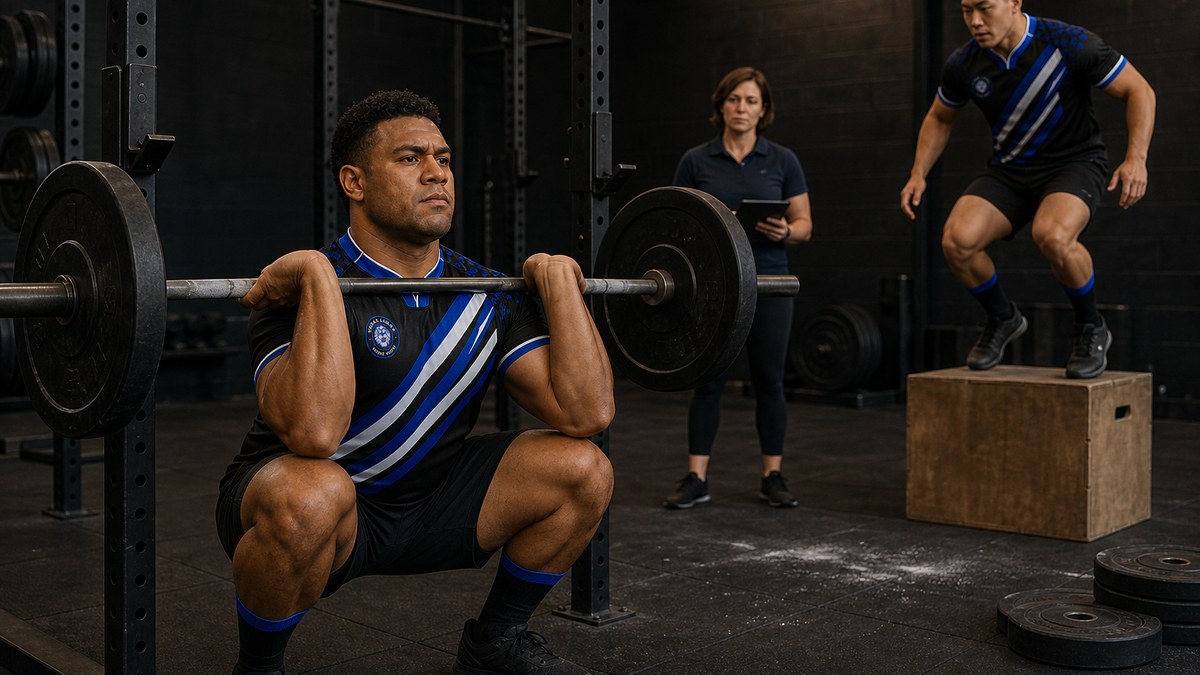
What does an in-season strength session look like?
The big change from pre-season is volume, not intensity. World Rugby's course notes that "with a relatively low volume of high intensity efforts, strength and power adaptations can be maintained in-season." Its example two-day in-season microcycle (shown in the course, not as a personal prescription) looks like this:
| Day | Example exercises (World Rugby course) | Typical loading in the example |
|---|---|---|
| Day 1 | Box jumps, hex bar deadlift, bench press, weighted plank, dead bugs | Main lifts 4–5 sets of 4–6 reps at RPE 7–9; jumps 3–4 sets |
| Day 2 | Low-load jump squats, power cleans, front squat, weighted pull-ups, suitcase carry | Main lifts 4–5 sets of 4–6 reps at RPE 7–9; jumps 3–4 sets |
RPE (rating of perceived exertion) on a 1–10 scale means the sets are hard but not all-out: there are still a rep or two left in the tank. That's a common thread in in-season programming. Key principles most strength coaches follow:
- Keep it heavy, keep it short. A few quality sets of the big lifts preserve strength. Endless accessory work just adds fatigue.
- Pair strength with speed. Jumps, light jump squats and Olympic lift variations keep the "explosive" in explosive strength. Our plyometrics guide covers the basics.
- Don't forget the legs. The sevens data shows lower-body strength is the easiest thing to lose when rugby training is leg-heavy. Protect the squat and hinge.
- Train the trunk and grip. Carries, planks and pull-ups support tackling, rucking and ball security.
- Technique first. In-season is not the time to chase personal bests with poor form. If a lift looks ugly, the load comes down.
Lions don't stop hunting when the season starts. We just hunt smarter. Two short, sharp sessions that leave you feeling stronger walking out than walking in are worth more than one heroic session that leaves you sore on match day.
How do you fit lifting around games?
Timing matters as much as content. Every team's week is different, but many coaches build it around a few simple ideas:
- Recover first. The day or two after a game is usually about recovery and light movement, not heavy lifting, especially after a high-contact match.
- Lift early in the week. The heaviest strength session often sits early in the week, giving time to recover before the next game.
- Keep the pre-game session light and fast. If there's a second session, it's often lower volume and more explosive, finishing a few days before kickoff.
- Adjust to the fixture. Short turnarounds, travel and bye weeks change the plan. A bye week can be a chance for a slightly bigger strength block.
- Listen to the body. Bumps and bruises are part of rugby. Swap or skip exercises that aggravate an injury and speak to a doctor or physiotherapist about anything more than routine soreness.
Training load also needs to stay steady. Tim Gabbett's widely cited 2016 review in the British Journal of Sports Medicine argued that "excessive and rapid increases in training loads are likely responsible for a large proportion of non-contact, soft-tissue injuries," but also that "reductions in workloads may not always be the best approach to protect against injury." Athletes used to appropriately graded, high training loads tended to be fitter and more robust. The practical lesson: avoid big swings. Don't skip the gym for a month and then smash it all at once.
| Season phase | Main strength goal | What usually changes |
|---|---|---|
| Off-season | Recover, address weaknesses, rebuild general strength | Higher variety, lower rugby load |
| Pre-season | Build maximum strength and power | Highest lifting volume, 3 or more sessions a week common |
| Early to mid-season | Keep improving if possible, at least maintain | Fewer sets, intensity kept high, around 2 sessions a week |
| Late season / finals | Maintain strength, stay fresh | Lowest volume, speed and quality emphasized |
If you want to see how the pre-season side is built, the Vegas Kings' 6-week pre-season conditioning plan is the natural first step. Conditioning has to be maintained too: the Vegas Knights' guide to fitness for defenders explains repeat-effort conditioning for the tackle-heavy parts of the game.
Do forwards and backs train differently in-season?
Most in-season programs share the same backbone, but the emphasis can shift by position. The Vegas Kings' rugby positions guide explains what each role does.
- Props, hookers and locks spend the season in scrums, mauls and rucks. Coaches often prioritize maintaining heavy lower-body and trunk strength and neck conditioning under supervision. The Vegas Blackjacks' scrum technique guide shows the positions that strength has to support.
- Back-rowers carry and tackle the most, so they often carry the biggest contact load. Managing total volume matters for them.
- Backs need to keep sprint speed and acceleration. Many programs keep more jumping and sprint work alongside the heavy lifts. Our acceleration guide explains why.
Everyone benefits from strong legs. The leg drive that wins the gainline and the tackle technique that stops it both rely on it.
Does in-season strength matter for the APR Games?
The APR Games 2027 are 10-a-side rugby, two 20-minute halves, Memorial Day weekend, May 29–31, 2027, in Las Vegas, with at least three pool games per team. That's a short, intense "season" packed into a few days. The same principles apply on a smaller scale: arrive strong, then stay fresh. Heavy, high-volume lifting in the days before a tournament usually does more harm than good. Most players will be better served by building strength in the months before, then tapering volume while keeping some short, sharp work in the final weeks. The Kings' guide to rugby tens explains why the format rewards players who can make repeated high-intensity efforts.
If you play club rugby through the spring, the APR Games may land near the end of your own season, so in-season maintenance is exactly what will decide whether you arrive at your best. New to the sport as an adult? Downtown Rugby's guide to starting rugby as an adult is a good place to begin.
Bring your strength to the APR Games
The APR Games 2027 run Memorial Day weekend, May 29–31, in Las Vegas: 10-a-side rugby, two 20-minute halves under the lights. Men's Elite ($10,000 prize pool), Women's Social ($5,000) and Youth divisions. Player entry $299 includes a team jersey, kit bag, at least three pool games and opening-night access.
Join the APR Games waitlistWant to learn from coaches in person? The APR coaching clinic runs May 28–31, 2027, in Las Vegas. The Lions are one of five founding franchises of American Pro Rugby; meet the others on the APR teams page, follow the wider game on APR's rugby news and pick up training gear at the APR merch store.
A long season takes energy on and off the pitch, and our energy partner WXE is one of the businesses backing APR. And when your club or business has something to celebrate at the end of the season, our partner Giftabiz does gifts and video messages for business launches.
Want one skill broken down and a strength block every week? Join The Breakdown, APR's free weekly newsletter.
Frequently asked questions
What is in-season strength training in rugby?
It is the resistance training players keep doing once the competitive season starts. The goal is to at least maintain, and ideally keep improving, the strength and power built in pre-season, while managing fatigue around games.
How many times a week should rugby players lift in-season?
World Rugby's coaching course says two resistance sessions a week is achievable in-season. Research in soccer players found one session a week maintained strength for 12 weeks, while one session every second week did not. The right number depends on the fixture list and should be set with a coach.
How long does it take to lose strength if you stop lifting?
A 2013 systematic review of rugby and American football players found strength can be maintained for up to about three weeks without training, after which it declines faster. Over detraining periods averaging around seven weeks, strength fell by about 14.5%.
Should in-season lifting be lighter?
Usually the volume drops but the intensity stays fairly high. World Rugby's course says a relatively low volume of high-intensity efforts can maintain strength and power in-season. Fewer sets, still heavy enough to matter, with good technique.
Does losing strength affect tackling?
Research in semiprofessional rugby league players found that changes in squat strength during the season were related to changes in tackling ability. Players who kept their lower-body strength improved their tackling, while those who lost strength tended to get worse.
When should I lift during a game week?
Many coaches put the heaviest session early in the week after recovery, and keep any second session short and explosive a few days before the game. Your coach will plan this around your schedule and the fixture list.
Should I lift the day before a game?
Heavy, high-volume lifting the day before a game is generally avoided because it can leave you fatigued. Some programs use very short, light, fast activation work close to a game, but that is a decision for your coach.
Is it safe to lift when I'm sore or injured?
Routine soreness is part of rugby, but lifting through an injury is not. Swap exercises that aggravate a problem and see a doctor or physiotherapist about anything more than normal soreness before training.
Do backs need in-season strength training too?
Yes. Backs make tackles, carry into contact and need to keep sprint speed. Their programs often keep more jumps and sprint work, but lower-body strength still matters for every position.
Can I keep getting stronger during the season?
It is possible, especially early in the season. A study of professional rugby union players found power still rose from pre-season to mid-season, with the biggest declines only late in the season. Consistent, well-planned sessions give you the best chance.
Keep reading
Sources
- World Rugby Passport: Advanced Conditioning for Rugby, In-season maintenance (accessed November 2026)
- McMaster DT, Gill N, Cronin J, McGuigan M. The development, retention and decay rates of strength and power in elite rugby union, rugby league and American football: a systematic review. Sports Medicine 43(5):367–384, 2013
- Gannon E, Stokes K, Trewartha G. Strength and power development in professional rugby union players over a training and playing season. International Journal of Sports Physiology and Performance 11(3):381–387, 2016
- Speranza MJA, Gabbett TJ, Greene DA, Johnston RD, Sheppard JM. Changes in rugby league tackling ability during a competitive season: the relationship with strength and power qualities. Journal of Strength and Conditioning Research 31(12):3311–3318, 2017
- Rønnestad BR, Nymark BS, Raastad T. Effects of in-season strength maintenance training frequency in professional soccer players. Journal of Strength and Conditioning Research 25(10):2653–2660, 2011
- Gabbett TJ. The training-injury prevention paradox: should athletes be training smarter and harder? British Journal of Sports Medicine 50(5):273–280, 2016
- Speranza MJA, Gabbett TJ, Johnston RD, Sheppard JM. Effect of strength and power training on tackling ability in semiprofessional rugby league players. Journal of Strength and Conditioning Research 30(2):336–343, 2016
- American Pro Rugby: APR Games 2027
This guide is general information, not individual coaching or medical advice. Strength training and contact rugby carry a risk of injury: follow a program set by a qualified strength and conditioning coach, use good technique, and consult a doctor or physiotherapist before training after an injury or if you have any health concerns.